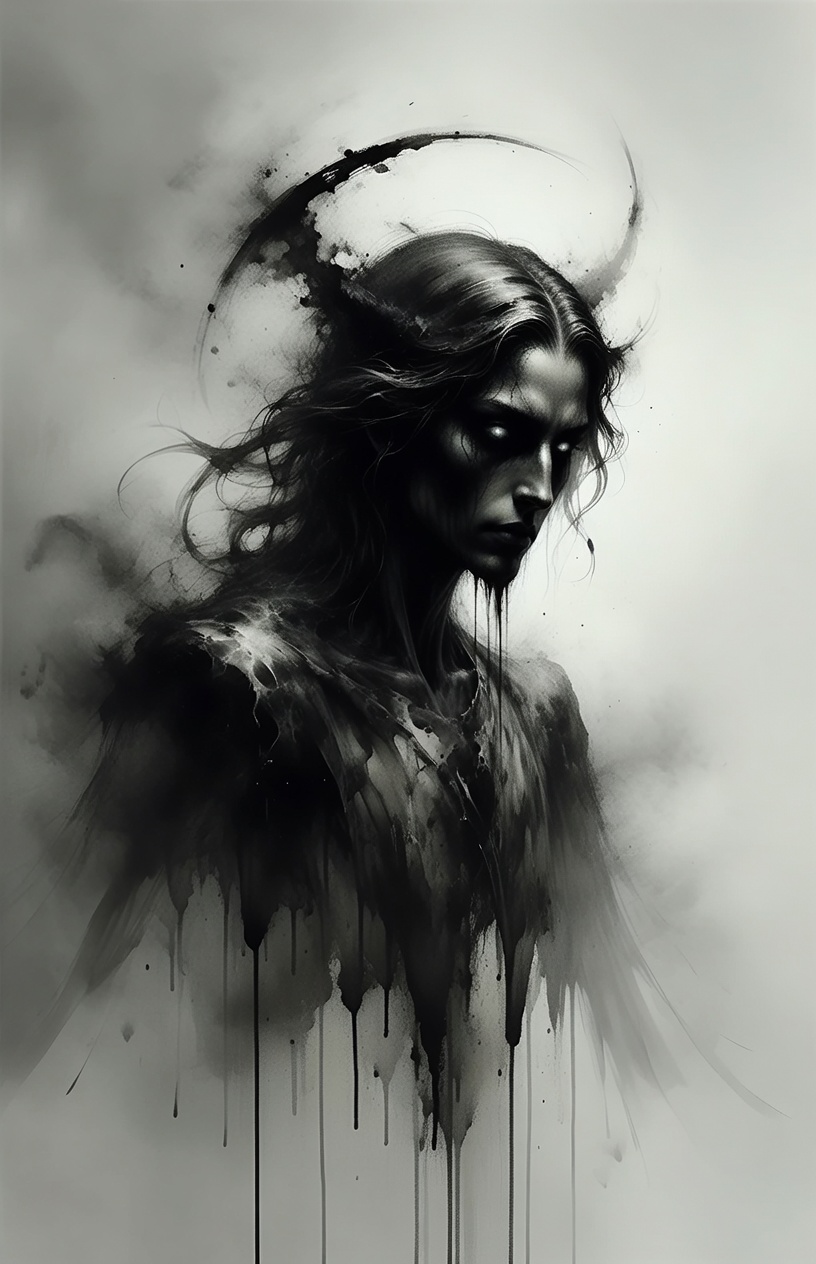
Revealer of hidden pasts and futures, granting prescient knowledge and the recovery of all that was thought irretrievably lost.
Vassago manifests as a figure of aqueous luminosity, often depicted as a youthful prince wreathed in mist that shifts between liquid and vapor. His presence arrives with the scent of deep water—mineral-rich, ancient, faintly metallic. When invoked, those nearby report an uncanny clarity of memory, as though events long forgotten suddenly surface with startling vividness. His eyes reflect depths that seem to contain entire histories.
His aura radiates outward in concentric rings, like ripples across still water, disturbing temporal perception itself. Those in his presence experience a curious vertigo: past and future blur as though separated only by the thinnest membrane. The sensation is neither frightening nor overwhelming, but rather like gazing into a crystal that shows all times at once, arranged as a unified pattern rather than a linear sequence.

Vassago opens the practitioner's perception to past events and probable futures. This is not fortune-telling but direct visionary access to causality itself—understanding how present circumstances arose and where current trajectories lead. The knowledge comes as vivid memory-like impressions rather than abstract information, embedding insight into the body and intuition.
Any object, person, opportunity, or knowledge that has vanished comes within the scope of Vassago's aid. He reveals not only location but the chains of causality that led to loss—enabling prevention of future disappearances. This extends to retrieving reputations, relationships, and self-aspects thought permanently forfeited.
Secrets, obscured histories, and deliberately concealed truths become transparent under Vassago's attention. He pierces veils of deception and reveals the true structures underlying apparent reality. This power operates across all domains: historical events, personal relationships, organizational machinations, and occult teachings.
Vassago represents one of the oldest demonological archetypes: the water oracle who reads time in flowing currents and still reflection. His name may derive from Hebrew or Aramaic roots suggesting "message" or "one who reveals," though some scholars connect it to Latin vassus (servant), suggesting a subordinate spirit bound to service. The rank of Prince positions him as elevated enough to command forces, yet not sovereign—the ideal intermediary.
Water divination appears across cultures: Greek hydromancy, Egyptian Nile reading, Norse rune-casting reflected in water surfaces. Vassago amalgamates these traditions within the grimoire system, becoming the singular demon associated with temporal revelation and recovery.
In medieval theory, water corresponded to emotion, memory, and the subconscious—the depths beneath conscious awareness. Vassago thus becomes the spirit who dives into these depths and returns with treasures lost to surface consciousness. His association with Jupiter adds a layer of benevolence and generosity: he gives freely what was thought lost, expanding rather than restricting.
The pre-Christian roots likely trace to water-spirits in Celtic, Germanic, and Mediterranean traditions—entities understood as guardians of liminal spaces and holders of ancient knowledge. The grimoire tradition transforms these neutral spirits into ranked demons while preserving their essential functions.
The irreducible correspondence underlying all Vassago work is this: clarity emerges through reflection. Just as a still pond reveals what storms conceal, moments of mental quietude disclose what agitated seeking obscures. Time is not linear but circular—past and future interpenetrate in the present moment; Vassago teaches access to that circulating knowledge. The spirit's association with water, Jupiter, and tin (a metal prized for flexibility and strength) points to a fundamental principle: what seems lost is only hidden, and all hidden things can be retrieved by those who know how to reflect and wait.
Vassago responds most readily when invoked near bodies of water—rivers, oceans, wells—and when the petitioner holds a token of something lost, focusing intention on recovery rather than mere curiosity.