The history of demonological tradition — from the legend of King Solomon to the art of summoning the seventy-two spirits of the Ars Goetia.
King Solomon, third king of Israel and son of David, stands as the central figure in demonological tradition. According to the Testament of Solomon — a pseudepigraphical text preserved from the 1st to 5th century AD — the young king faced a crisis when a demon named Ornias tormented a boy favored by the royal court. In Solomon's moment of desperation, the archangel Michael descended from the celestial realms and bestowed upon the king a magical ring, engraved with the Seal of God itself.
Solomon's power proved absolute. He first bound Ornias, then compelled that demon to reveal the identity of the prince of all demons — Beelzebul. Through Beelzebul, the king's dominion extended to all seventy-two spirits of Hell. Bound by oath and seal, these entities became enslaved to Solomon's will. He forced them to labor in the construction of the Temple of Jerusalem, tasks beyond mortal strength: they carried great stones, shaped metal, and performed works that transcended human capability.
When the temple stood complete, these spirits were sealed within a great brass vessel, inscribed with holy names and divine symbols, and cast into the deep places of the earth — imprisoned until the end of days.
The Lesser Key of Solomon, known in its original Latin as the Lemegeton Clavicula Salomonis, is a 17th-century grimoire that draws from much older sources stretching back centuries into antiquity. Its compilation represents a synthesis of multiple occult traditions: Johann Weyer's Pseudomonarchia Daemonum provided a listing of 69 demons; Heinrich Cornelius Agrippa's Three Books of Occult Philosophy contributed sophisticated magical theory; the Heptameron offered additional ceremonial knowledge; and a mysterious 15th-century French manuscript known as the Livre des Esperitz supplied further demonological insights.
The most famous edition, published in 1904 by S.L. MacGregor Mathers and Aleister Crowley under the title "The Book of the Goetia of Solomon the King," became the standard reference for modern practitioners and scholars of ceremonial magic.
The art of commanding the 72 demons, detailing their seals, ranks, legions, and the proper methods of summoning and controlling them through ritual and sacred geometry.
The spirits of the four compass points and the cardinal directions, derived from Trithemius's Steganographia, blending demonic and divine forces aligned with the pillars of creation.
The celestial correspondence system, governing the 24 angels of the hours and the 360 spirits of the zodiacal degrees, allowing invocation of divine assistance through planetary and stellar influences.
Instructions for the creation of a wax scrying tablet, a tool for establishing contact with the angels through vision and divination, facilitating communion with celestial intelligences.
A system devoted to the acquisition of knowledge through sacred prayer and divine invocation, permitting the student of magic to access divine wisdom beyond ordinary human learning.
The 72 spirits are organized according to a feudal hierarchy that mirrors the structure of medieval European courts, with power descending through ranks of nobility. Each rank is associated with a celestial body and a corresponding metal, establishing connections between the terrestrial and the cosmic.
Sovereign rulers commanding hundreds of legions, wielders of absolute authority over lesser spirits.
Noble spirits of considerable power, rulers of territories and commanders of vast demonic forces.
High-ranking spirits of authority, holding dominion over lesser demons and wielding substantial magical influence.
Border guardians dwelling between the realms, masters of thresholds and transitions between worlds.
Martial spirits embodying discipline, conflict, and the exercise of force and power over others.
Furcas, a singular and patient teacher, the sole knight of the infernal hierarchy, known for wisdom and instruction.
Spirits of knowledge and rhetoric, possessing mastery of language, communication, and hidden wisdom.
The practice of Goetia demands an elaborate and precisely ordered ritual framework, for the demonic spirits are bound by sacred law and respond only to authority properly invoked. The magician must stand within a Magic Circle nine feet in diameter, inscribed with divine names of power — YHVH, Adonai, Agla — and the names of the four archangels who stand at the cardinal points: Uriel, Raphael, Michael, and Gabriel. This circle serves as an inviolable fortress, protecting the operator from the forces arrayed against them.
Outside the protective circle, the Triangle of Art is inscribed upon the ground or upon parchment, marked with the name and sigil of the spirit being summoned. Within this triangle the demon is commanded to manifest in visible form. The magician is armed with essential tools of power: the wand of authority, gripped in the right hand, serves as an instrument of command; the sword of banishment, held in the left, stands ready to constrain or dismiss any spirit that refuses obedience. Around the neck or upon the breast hangs the Ring of Solomon — the hexagonal lamen engraved with the spirit's unique seal — a symbol of unbreakable binding and proof of the magician's legitimate authority.
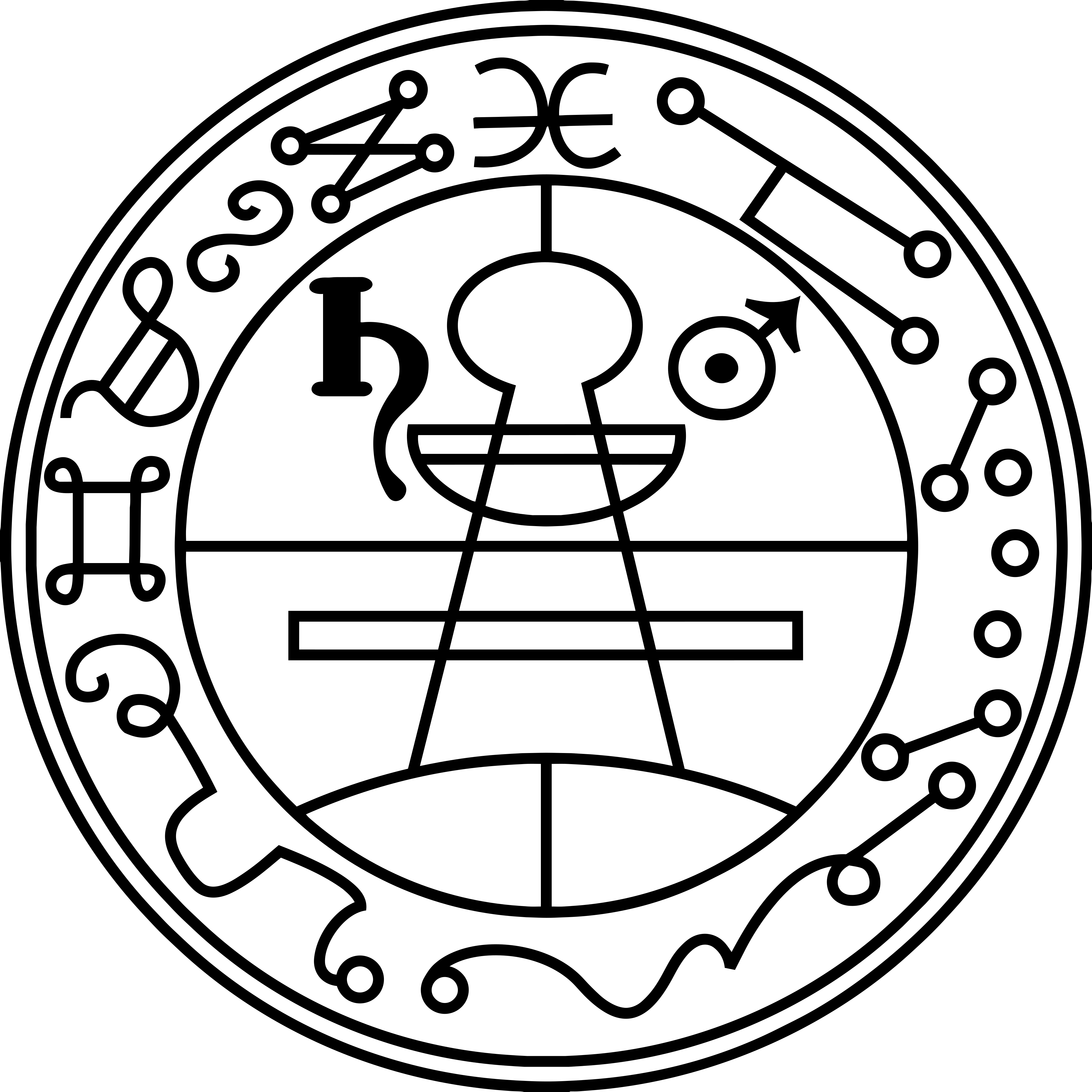
Each of the 72 spirits possesses a unique sigil — its magical signature and key — which serves as the seal of their name and their essential nature. These sigils must be drawn with utmost precision and exactitude, for they establish the point of contact between the material world and the infernal realm. When drawn correctly and invoked with proper intention and authority, a sigil becomes a gateway through which the spirit's power may be channeled. Should a spirit prove disobedient or dangerous, the magician may contain it within a brass vessel inscribed with holy names, sealing its power until it is released or dismissed. Thus the Art of Goetia remains, throughout the ages, a system of power balanced upon knowledge, authority, and the inviolable bonds of sacred law.