No. 04 — Marquis

Samigina

Keeper of hidden sciences and guardian of the boundary between life and death, granting mastery of learning and communion with departed souls.

Samigina — manifestation

Samigina manifests as a luminous yet shadowed figure, neither fully solid nor entirely spectral. His presence is accompanied by the scent of rain on stone and autumn wind. When invoked, those nearby experience an uncanny pull toward introspection and memory; the veil between the living and the dead seems perceptibly thinner. His eyes reflect an ancient sorrow—the weighted knowledge of countless departed conversations.

His aura shimmers between visible and invisible, as though he occupies multiple states simultaneously. A subtle chill accompanies his presence, not from cold but from the touch of otherworldly knowledge. Time itself seems to slow in his vicinity, and silence becomes eloquent—pregnant with the unspoken wisdom of those no longer embodied.
Powers
SCHOLAR
Confers mastery of liberal sciences, philosophy, geometry, and all theoretical knowledge
PSYCHOPOMP
Enables communication with spirits, ghosts, and the deceased
LIBERATOR
Grants freedom from ignorance and restrictive belief systems
THRESHOLDER
Guides safe passage through liminal spaces and transitional states
Rank
Marquis
Legions
30
Sphere
Moon
Element
Water
West / Dusk
Seal
See Grimoire
Notation Below
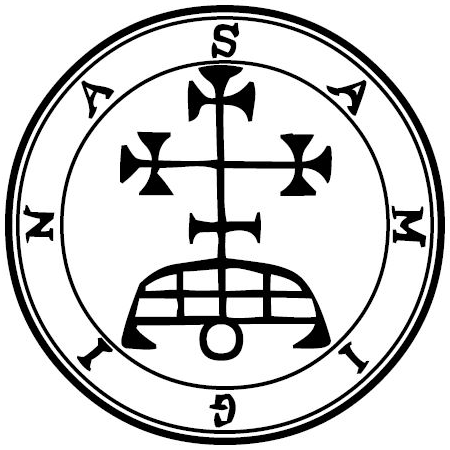
Seal of Samigina
Powers & Dominion 3 recorded abilities
01 Liberal Sciences Mastery

Samigina grants comprehensive understanding of mathematics, geometry, astronomy, philosophy, and all disciplines that map the structure of reality. The knowledge arrives not as memorized facts but as intuitive comprehension—the practitioner suddenly grasps the underlying logic of complex systems. This extends to understanding the hidden geometry of consciousness and the mathematical principles governing spiritual manifestation.

knowledge learning understanding
02 Necromantic Communication

The spirit of the dead answer summons when Samigina mediates. This is not coercive spiritualism but respectful necromancy—deceased souls choose to communicate, guided by Samigina's authority and wisdom. Information from the departed arrives with clarity; their knowledge of past events and hidden truths becomes directly accessible to the living.

death communication wisdom
03 Illumination Through Contradiction

Samigina teaches that all systems of thought contain necessary paradoxes. He illuminates the contradictions within belief systems, freeing practitioners from dogmatic attachment. This power operates most strongly during initiation and transformation, enabling the dissolution of old knowledge-structures to make room for more comprehensive understanding.

wisdom initiation freedom
Deep Lore
I
Historical Origins
Scholar-Demon and Gateway-Guardian in Ancient Tradition

Samigina (also called Gamigin) embodies the archetype of the liminal scholar—the spirit who stands at the threshold between knowledge and mystery, living and dead. His name may derive from Hebrew roots suggesting "hearkening" or "one who listens," indicating his role as an auditor of secrets and a recorder of hidden knowledge. The rank of Marquis positions him as a principality of considerable authority, ruling over the knowledge-systems and boundary-transitions he governs.

The demon appears in some of the earliest medieval grimoires, suggesting roots in classical necromancy and philosophical magic. Pre-Christian sources include references to threshold-guardians in Greco-Roman mystery traditions—spirits who verified initiates' understanding before permitting access to sacred knowledge.

Samigina's association with liberal sciences reflects medieval curriculum divisions—the trivium (grammar, logic, rhetoric) and quadrivium (arithmetic, geometry, music, astronomy). These were understood not merely as academic subjects but as keys to deciphering the structure of divine creation. The spirit becomes a patron of those engaged in scholarly work and initiation-knowledge.

His connection to necromancy likely stems from the medieval understanding that the dead possess unmediated knowledge—freed from embodied limitation, spirits retain memory and can perceive truth unfiltered by living fears. Samigina serves as the honored intermediary in these dialogues, ensuring respect and truthfulness on both sides of death.

500–100 BCE
Greco-Roman Mystery Initiation
Threshold-guardians in Eleusinian and Orphic mysteries serve functions similar to Samigina's—verifying understanding and permitting passage between states of knowledge.
1000–1200 CE
Medieval Grimoire Origins
Samigina appears as a formal spirit in early handwritten grimoires, his attributes emphasizing both scholarly mastery and necromantic communication.
1563 CE
Weyer's Codification
Pseudomonarchia Daemonum establishes Samigina as fourth-ranked Marquis with 30 legions, creating canonical authority that propagates through subsequent systems.
1670s CE
Ars Goetia Systematization
The Lesser Key of Solomon codifies Samigina with elaborate seals and ritual correspondences, establishing him as a major spirit for serious practitioners.
II
Grimoire Variations
Scholarly and Necromantic Traditions Across Sources
"Samigina standeth as the gate between knowledge and knowing, between the living scholar and the departed sage. Through his mediation, the furthest wisdom becomes accessible."
Ars Goetia (Lesser Key of Solomon)
~1670s
"The Fourth Spirit is a Marquis called Samigina, or Gamigin... He teacheth all Liberal Sciences... He speaketh with a hoarse voice... He delighteth in sacrifices."
The Ars Goetia emphasizes his scholarly authority while noting his distinctive harsh voice—suggesting the gravitas of one who speaks from proximity to death.
Pseudomonarchia Daemonum (Weyer)
1563
"Samigina, a Marquis, teaching all liberal sciences, and willing to give account of the dead."
Weyer's version explicitly connects scholarship with necromantic function, establishing the interdependence of these two power-domains.
Book of Abramelin
15th century
"Samigina giveth understanding of all sciences and the faculty of communion with those beyond the veil. He serveth in the Art of Knowledge-Mastery and the Rite of Ancestral Speaking."
The Abramelin tradition frames his powers as learnable arts and establishes regular devotional practice as the path to his teaching.
III
Cultural Legacy
The Scholar-Spirit in Literature and Modern Practice
FICTION & OCCULT LITERATURE
The Helpful Death-Keeper
Contemporary occult fiction frequently portrays Samigina as the demon invoked not out of fear but out of genuine intellectual need. Modern grimoire authors emphasize his benevolence toward sincere scholars and his guardianship of the dead. Stories often feature Samigina as a mentor-figure, teaching protagonists that true knowledge requires understanding both life's joys and death's sober truths.
DEAD
SHADE
SCHOLARLY & ACADEMIC MAGIC
Patron of Learning and Research
Academic practitioners and scholarly magicians invoke Samigina for clarity in research and protection during intellectual work. His association with liberal sciences makes him a natural patron for those engaged in advanced studies. Some university-based occultists maintain shrines to Samigina in their offices, treating him as a muse and intellectual guardian.
CONTEMPORARY SPIRITUALISM
Ethical Necromancy and Ancestral Work
Modern practitioners invoke Samigina when engaged in respectful communication with the deceased. His reputation for honoring both the living and the dead makes him essential in grief-work and ancestor veneration. Practitioners use his correspondences to establish ethical frameworks for mediumship, ensuring that work with spirits operates under principles of mutual respect and consent.
GRIEF
IV
Ritual Traditions
Four Methods for Invoking Samigina's Scholarly and Necromantic Powers
01
Solomonic Scholarly Circle
Formal ritual conducted in a space dedicated to learning—library, study, or shrine. The practitioner creates a circle oriented to the North (Moon's correspondence), surrounding it with symbols of the liberal sciences (compass, astrolabe, books). Mercury-day (Wednesday) timing is preferred. Offerings include wine, honey, and written questions or petitions inscribed on parchment. The invocation requests clarity for scholarly work; results manifest as sudden insight, vivid dreams, or encounters with relevant texts.
02
Ancestral Necromancy
Conducted at twilight near a graveyard or ancestral site. Practitioner invokes Samigina first as a guarantor of ethical communication, then calls specific deceased persons. The spirit acts as mediator, ensuring honest exchange between living and dead. Communication may occur through direct speech, automatic writing, or symbolic dreams. This method requires emotional maturity and respect for the deceased; violations of ethical boundary result in Samigina's withdrawal.
03
Knowledge-Mastery Meditation
No external tools required. Practitioner sits in contemplation, focusing on a specific subject to be mastered. They invoke Samigina mentally, requesting illumination of the subject's hidden structure and principles. The meditation operates by dissolving mental blockages and attachments to partial understanding. Clarity emerges not as revelation but as sudden, self-evident comprehension—the subject's logic becomes obvious, its paradoxes resolved.
04
Devotional Scholarly Practice
Establishing ongoing relationship through consistent learning and remembrance. Practitioners maintain an altar to Samigina in their study space, making regular offerings of newly acquired knowledge—notes, summaries, insights from study. They speak to him as a mentor, sharing questions and discoveries. This method emphasizes that knowledge-mastery is a lifelong practice requiring sustained dedication and respect for learning itself.
"The dead know what the living cannot: they have stood where all knowledge ends and truth becomes unassailable. Samigina grants us access to this clarity without requiring death itself."

The irreducible correspondence at the heart of Samigina work is this: knowledge and death are intimately connected. Every understanding requires the death of previous ignorance; every system of thought contains unresolved paradoxes that point toward mysteries beyond its scope. True scholarship is spiritual work—it demands ego-death, the surrender of comfortable certainties, and willingness to be proven wrong. Samigina teaches that the liberal sciences are not abstractions but living systems, each rooted in profound truths about reality's structure. Work with this spirit elevates learning from mere accumulation of facts into a transformative practice of encountering Being itself.

Classification
RankMarquis — sovereign authority
Legions30 — spirits under direct command
PlanetMoon — ☽
MetalSilver — Ag
ElementWater
SummoningMonday or night
SealRequired — inscribed on lamen or parchment
Invocation
Samigina, keeper of the deepest lore,
Who walks between the living and the dead,
Grant me the learning centuries explore,
And truth that charts what lies ahead.

Samigina responds most readily during twilight hours (dawn or dusk), when the boundary between day and night is permeable. Invocation should occur near places of scholarly work or near graves, where the veil is thin.

← Previous
Vassago
No. 03 — Prince
Explore
Lore
History & Origins
Next →
Marbas
No. 05 — President