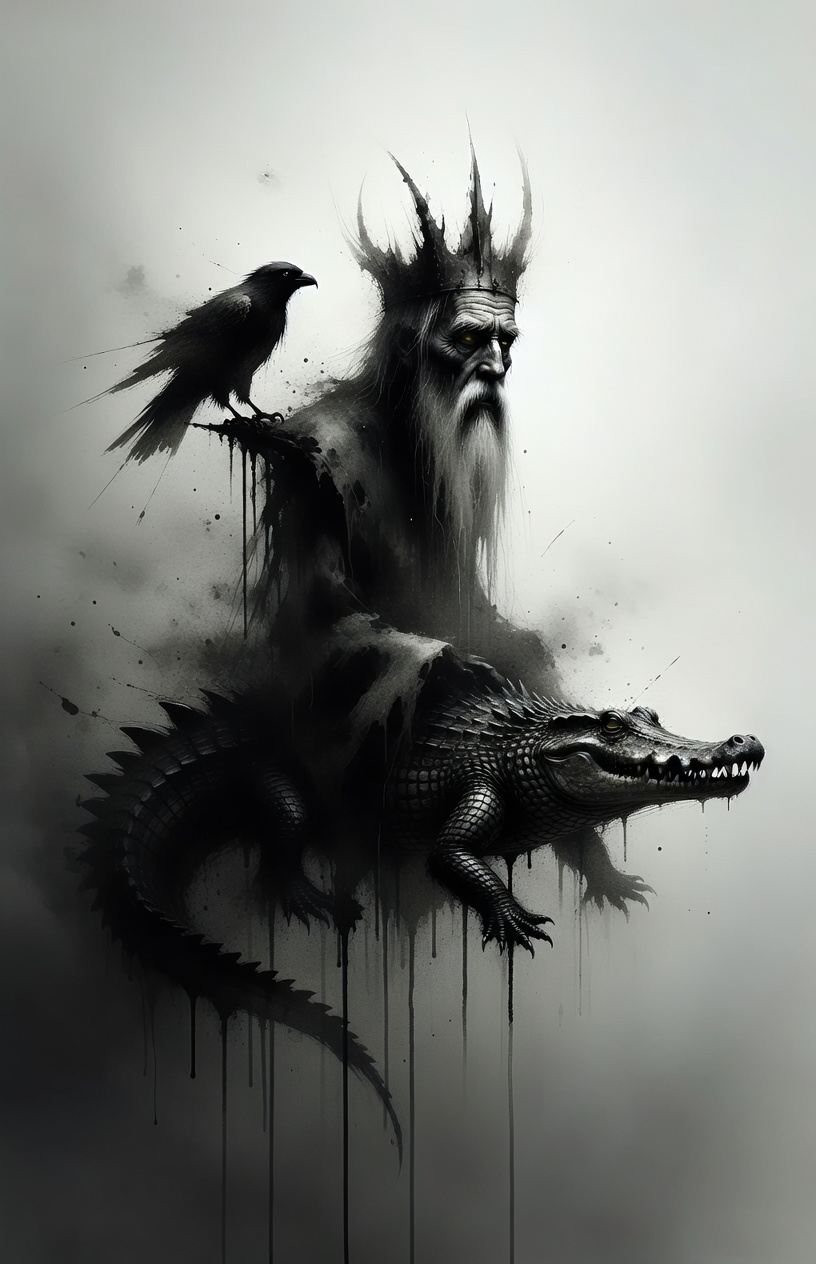
Master of tongues and terrestrial upheaval, granting language mastery and command over earthbound forces.
Agares manifests as a stately figure mounted upon a pale dragon or crocodile, bearing the countenance of a nobleman in antiquated dress. His presence carries the scent of dry earth and shifted stone. When invoked, the air grows thick with an almost palpable weight—as though the ground beneath your feet has become conscious and attentive. Those in his presence report an uncanny awareness of their own linguistic limitations suddenly dissolving.
His aura crackles with a peculiar energy: simultaneously grounding and destabilizing. The space around him seems to compress, as though language itself becomes a tangible medium he manipulates with ease. His eyes reflect an ancient knowledge of human speech in all its forms, from the commonplace to the forgotten tongues of lost civilizations.
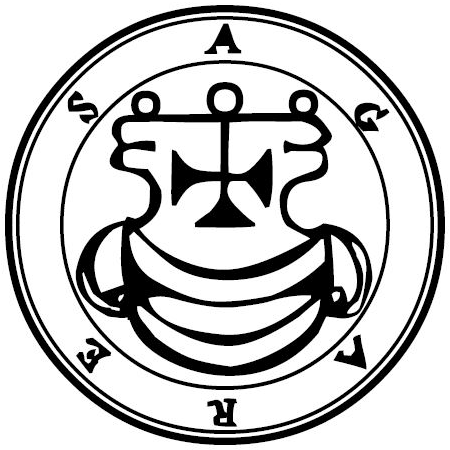
Agares bestows complete fluency in any language—ancient Sumerian, demotic Egyptian, forgotten dialects. The invocant understands not merely words but the cultural context, idiom, and unspoken meanings beneath each utterance. This extends to animal tongues and the symbolic languages of dreams.
The invoker gains authority over earth itself. Earthquakes obey summons with surgical precision. The ground beneath enemies becomes treacherous; safe passage opens for allies. This power extends to locating treasures hidden in soil and stone, reading geological memory.
Agares grants supernatural speed and the ability to compel others toward or away from a location. Enemies find themselves drawn inexorably toward the invoker; fugitives vanish into landscapes as though swallowed by the earth itself. Time seems to bend in favor of swift movement.
Agares appears in the Ars Goetia as the second spirit, a rank suggesting significant antiquity in demonological tradition. Scholars trace his lineage to Mesopotamian boundary deities—specifically those spirits associated with the liminal spaces between cultivated land and wilderness. His name may derive from Akkadian roots relating to "upheaval" or "to turn," reflecting both linguistic transformation and geological disruption.
The connection to language mastery likely emerges from ancient Near Eastern associations between territorial markers (boundary stones, stele) and the inscribed word. In cuneiform traditions, the written mark established dominion; Agares preserves this principle as dominion over all forms of linguistic expression.
By the medieval grimoire period, Agares had been fully absorbed into the Christian demonological schema. The Pseudomonarchia Daemonum (1563) and later the Ars Goetia (17th century) preserved his core attributes while recontextualizing them as infernal powers rather than neutral boundary forces.
His association with earthquakes may reflect medieval misunderstandings of tectonic activity—attributed not to natural causes but to demonic intervention. Yet the connection also preserves pre-Christian cosmologies where earth-spirits held genuine authority over geological phenomena.
Across all traditions, successful work with Agares hinges on recognizing that his powers are not arbitrary supernatural intrusions but expressions of deep correspondences. Language genuinely alters consciousness—learning a new tongue rewires neurological pathways and opens new possibilities for thought. Movement and stillness are not external effects but reflections of will and intention made manifest. The earthquake is both literal (in esoteric cosmology) and metaphorical (the trembling of old certainties). A practitioner who works with Agares must embody this logic: speak with precision, move with purpose, and understand that every utterance establishes a boundary and crosses it simultaneously.
Agares responds most readily to those who speak his name in a language other than their native tongue—a test of linguistic humility and a declaration of intent to master communication across all boundaries.