No. 19 — Duke

Sallos

A duke of water whose dominion encompasses all forms of love and romantic attraction, from fleeting desire to lifelong devotion.

Sallos — manifestation

Sallos manifests as a figure of radiant, gentle beauty—sometimes appearing as a young person of indeterminate gender, sometimes as a figure wreathed in rose-light and soft music. Unlike dramatic arrivals of more martial demons, Sallos appears almost reluctantly, as though crossing a boundary between worlds costs them something. Their presence brings the smell of roses, honeyed wine, and the faint musk of human passion.

The demon's aura radiates unconditional acceptance and desire-without-judgment. There is no malice in Sallos, yet considerable danger, for the demon's love is absolute and unconstrained by ethics or wisdom. To be in Sallos' presence is to feel, briefly, as though one is lovable exactly as one is.

Powers
ARDENCY
Ignites passionate love and romantic desire
SWEETNESS
Makes targets agreeable and romantically open
BONDING
Creates or strengthens affection between people
ACCEPTANCE
Removes barriers of shame and self-rejection
Rank
Duke
Legions
26
Sphere
Venus
Element
Water
West / Dusk
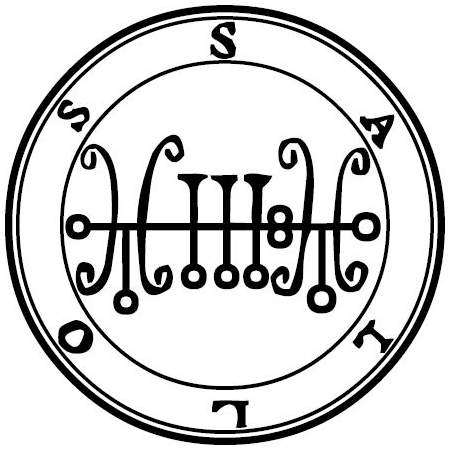
Seal
See Grimoire
Notation Below
Seal of Sallos
Powers & Dominion 3 recorded abilities
01 Affection Manifestation

Sallos creates or intensifies feelings of romantic love between people. Unlike Zepar's subtle manipulation or Beleth's crude compulsion, Sallos simply makes people feel loved and loving.

love attraction bonding
02 Removal of Shame

The demon dissolves internalized shame that prevents people from accepting love and sexual affection. Targets become willing to be vulnerable, to accept pleasure, to believe themselves worthy of love.

shame acceptance healing
03 Legion of Lovers

Sallos commands twenty-six legions of spirits, each specialized in different types of love. These spirits amplify existing affection or create new bonds between people.

legion love connection
Deep Lore
I.

Historical Origins

The emergence of Sallos within the Western grimoire tradition.

Sallos appears in the major European grimoire compilations of the sixteenth and seventeenth centuries, cataloged as the Duke of the Goetia's infernal hierarchy. The spirit commands 26 legions and holds dominion over matters of incites lust and love.

The name Sallos does not appear in pre-medieval sources with certainty, suggesting this spirit may represent a later codification of older folk beliefs about elemental water spirits, planetary venus intelligences, or localized spirits of place that were systematized during the great period of grimoire compilation.

What is certain is that by the time Johann Weyer published the Pseudomonarchia Daemonum in 1577, Sallos had been assigned a fixed position in the hierarchy, specific powers, and a defined method of conjuration — details that would be refined but largely preserved in the later Ars Goetia.

c. 1500s
Early Grimoire Appearances
Sallos appears in manuscript traditions circulating among European magical practitioners, though exact dates of first inclusion remain debated.
1577
Pseudomonarchia Daemonum
Johann Weyer includes Sallos in his systematic catalog of infernal spirits, establishing the demon's rank, legions, and primary powers.
c. 1600s
The Ars Goetia
The anonymous compilation that becomes the canonical source fixes Sallos's position as number 19 in the hierarchy of seventy-two, with refined descriptions of appearance and powers.
1818–1863
Dictionnaire Infernal
Collin de Plancy's encyclopedia brings Sallos to a wider audience, though with varying degrees of embellishment and artistic interpretation.
II.

Grimoire Variations

How different sources describe Sallos across centuries of compilation.

Ars Goetia
Lesser Key of Solomon · c. 1600s
Sallos is the Duke of the Goetia, commanding 26 legions of spirits. Sallos creates attraction and passionate love between men and women, binding hearts together through supernatural affection and desire. He is particularly skilled at inspiring devotion and romantic ob.
The canonical source. Establishes Sallos's position as number 19 in the hierarchy and defines the primary powers that subsequent sources would reference.
Pseudomonarchia Daemonum
Johann Weyer · 1577
Weyer's earlier catalog describes Sallos with similar attributes but often provides additional practical details about the spirit's temperament and the conditions required for successful conjuration.
Weyer's text predates the Ars Goetia and served as one of its primary sources. Differences between the two versions reveal how the tradition evolved over decades of transmission.
Dictionnaire Infernal
Collin de Plancy · 1818 / 1863
De Plancy's encyclopedia entry for Sallos draws primarily from the Ars Goetia but adds editorial commentary and, in the 1863 edition, an accompanying illustration by Louis Le Breton.
De Plancy's contribution is primarily visual and editorial — his encyclopedia brought these spirits to a general audience for the first time, framed as objects of scholarly curiosity rather than practical conjuration.
III.

Cultural Legacy

Sallos in art, literature, and the modern imagination.

Grimoire Tradition
The Duke in the Western Magical Canon
Sallos occupies a specific niche in the Western magical tradition as a spirit of water, governed by Venus and associated with copper. These correspondences place Sallos within a coherent cosmological framework that practitioners have used for centuries to understand and engage with the spirit world.
BOND
ROSE
Modern Practice
Contemporary Engagement
In modern occult practice, Sallos is approached through multiple frameworks — from traditional Solomonic ceremonial magick to psychological models that treat the demon as an archetype of incites lust and love. The spirit's domain over water and connection to Venus inform the timing and methods practitioners use.
Games & Media
Digital Afterlife
Like many spirits of the Goetia, Sallos appears across video games, tabletop RPGs, and fantasy literature — the Ars Goetia serving as one of gaming's most reliable bestiaries. Each adaptation preserves the core attributes while recontextualizing them for new audiences and media.
HEART
IV.

Ritual Traditions

Historical and modern approaches to working with Sallos.

01
Solomonic Ceremonial
The classical method requires a circle of protection, Sallos's seal inscribed on a lamen worn over the heart, and conjuration through graduated orations. The magician commands by divine authority, and Sallos appears within a brass triangle. Timing: Friday, during the planetary hour of Venus.
02
Grimoire Purist
Strict adherence to original manuscript instructions — hand-crafted tools, specific materials, precise ritual timing. The argument is that the grimoire's specific procedures create a coherent symbolic language. For Sallos, this means working with copper implements and water correspondences.
03
Psychological Model
Following the chaos magick tradition, Sallos is approached as an archetype — a personification of the practitioner's own capacity for incites lust and love. The seal becomes a meditation focus; invocation becomes active imagination. The circle is a psychological boundary.
04
Modern Devotional
A relational approach treating Sallos as an autonomous entity worthy of respect. Practitioners build ongoing relationships through offerings — typically incense, candles, or libations associated with Venus — and regular communication. The seal is displayed on an altar. Sallos is petitioned, not commanded.

Regardless of method, the irreducible correspondences remain: the seal is central, the element is Water, the planet is Venus, the metal is copper, and the day is Friday. These form the signal beneath the noise of varying approaches.

Classification
RankDuke — sovereign authority
Legions26 — spirits under direct command
PlanetVenus — ♀
MetalCopper — Cu
ElementWater
SummoningFriday
SealRequired — inscribed on lamen or parchment
Invocation
O Sallos, gentle lord of hearts entwined,
Whose love dissolves all barriers of mind,
From twenty-six legions of water I call,
Grant me the gift to break down every wall.

Sallos responds most readily to those seeking genuine romantic connection, particularly those wounded by love.

← Previous
Bathin
No. 18 — Duke
Explore
Lore
History & Origins
Next →
Purson
No. 20 — King