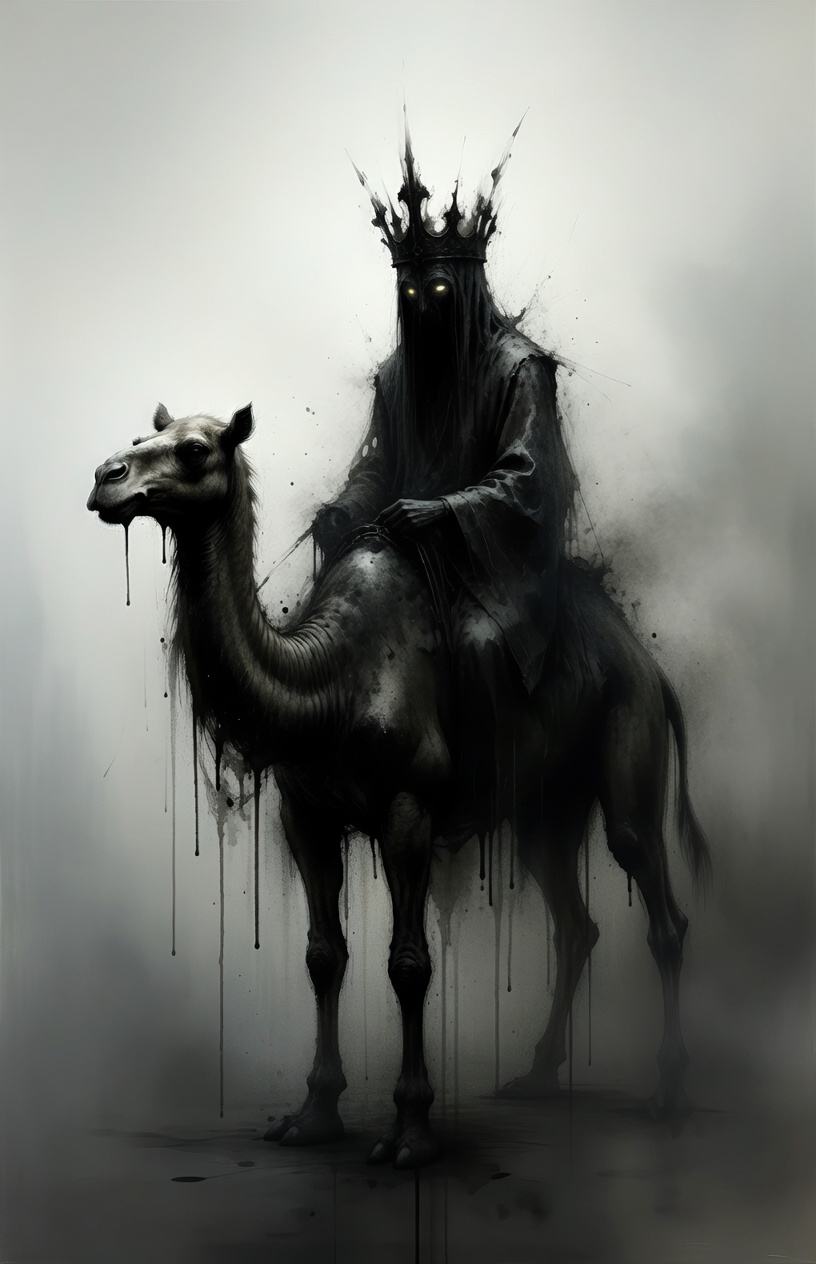
Grand Collector of Arts and Sciences, granting mastery of all human knowledge and the power to impart wisdom to others with supernatural eloquence.
Paimon manifests as a figure of absolute royal authority, often depicted as a great king riding upon a camel or as a being of pure light wreathed in symbols of knowledge. His presence fills the air with the scent of expensive perfumes, incense, and the library-dust of countless scrolls. When invoked, those nearby experience sudden expansion of perception—their understanding of complex subjects deepens, previously obscure connections become obvious, and the vastness of human knowledge becomes apprehensible.
His aura radiates outward with the absolute clarity of the sun at zenith. There exists a quality of supreme confidence and authority about his presence—the bearing of one who has mastered every art and science. The space around him becomes luminous with knowledge made manifest; confusion and uncertainty seem to dissolve in his light. His attention grants both honor and terror in equal measure.
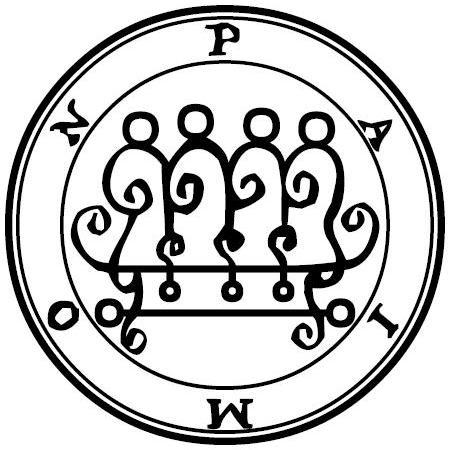
Paimon grants comprehensive understanding of all human knowledge—mathematics, philosophy, sciences, arts, crafts, divination. The knowledge arrives not as accumulation of facts but as integrated understanding of how all fields interconnect. A practitioner working with Paimon perceives the unity underlying apparent diversity; all knowledge becomes a single coherent system of which they possess complete comprehension.
The spirit confers the rare power to teach with supernatural effectiveness. When speaking of subjects Paimon has illuminated, the practitioner becomes almost impossibly clear and persuasive. Listeners understand not merely the words but the deep principles behind them. This power makes the practitioner an extraordinarily effective teacher and gives their words peculiar authority that compels attention and belief.
Paimon grants the bearing and presence of absolute authority—the aura of one who rules through superior understanding and capability. This extends beyond mere confidence to a quality that compels obedience and respect. Those in the practitioner's presence feel the weight of authentic mastery; their resistance naturally dissolves. This power is particularly potent in contexts of leadership, judgment, and the establishment of order.
The emergence of Paimon within the Western grimoire tradition.
Paimon appears in the major European grimoire compilations of the sixteenth and seventeenth centuries, cataloged as the King of the Goetia's infernal hierarchy. The spirit commands 200 legions and holds dominion over matters of grants wisdom and understanding of sciences.
The name Paimon does not appear in pre-medieval sources with certainty, suggesting this spirit may represent a later codification of older folk beliefs about elemental air spirits, planetary sun intelligences, or localized spirits of place that were systematized during the great period of grimoire compilation.
What is certain is that by the time Johann Weyer published the Pseudomonarchia Daemonum in 1577, Paimon had been assigned a fixed position in the hierarchy, specific powers, and a defined method of conjuration — details that would be refined but largely preserved in the later Ars Goetia.
How different sources describe Paimon across centuries of compilation.
Paimon in art, literature, and the modern imagination.
Historical and modern approaches to working with Paimon.
Regardless of method, the irreducible correspondences remain: the seal is central, the element is Air, the planet is Sun, the metal is gold, and the day is Sunday. These form the signal beneath the noise of varying approaches.
Paimon responds most readily to those pursuing genuine mastery rather than superficial knowledge. He favors practitioners approaching with humility before the vastness of learning and commitment to understanding rather than mere accumulation of facts.