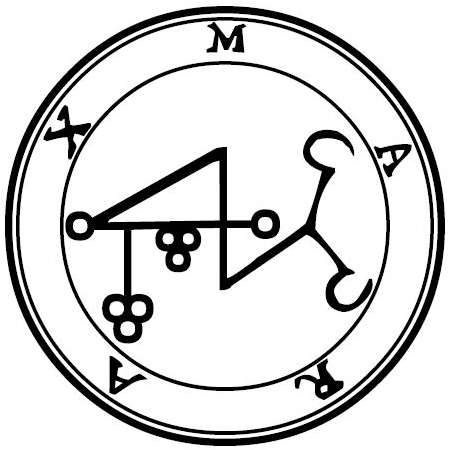
An earl and president of earth whose wisdom encompasses the sciences, astronomy, mathematics, and the rational understanding of natural phenomena.
Marax manifests as a figure of scholarly bearing, appearing sometimes as a robed scholar or astronomer, sometimes as a being whose form seems composed of geometric shapes and mathematical relationships. The demon's presence brings the smell of old books, ink, and the ozone scent of intense intellectual activity. Those in Marax's presence experience sudden clarity of mind, ability to perceive patterns and relationships previously invisible.
The demon's aura radiates pure intellectual power—the clarity that comes from understanding how things actually function. Unlike demons of emotion or desire, Marax carries no charge of seduction, merely the austere beauty of truth understood through rational investigation.
Marax can grant comprehensive understanding of scientific principles—how gravity functions, how chemical reactions occur, how biological systems develop. This understanding extends beyond theoretical knowledge into practical ability to apply principles.
The demon grants understanding of celestial mechanics, the movements of planets and stars, and mathematical relationships underlying the cosmos. This knowledge extends to understanding influences of celestial bodies on earthly phenomena.
Marax enables perception of mathematical and logical patterns underlying apparently chaotic phenomena. Data becomes readable; complex systems reveal their underlying logic. This power is particularly valuable for research, investigation, and scientific discovery.
The emergence of Marax within the Western grimoire tradition.
Marax appears in the major European grimoire compilations of the sixteenth and seventeenth centuries, cataloged as the Earl and President of the Goetia's infernal hierarchy. The spirit commands 36 legions and holds dominion over matters of teaches astronomy and natural philosophy.
The name Marax does not appear in pre-medieval sources with certainty, suggesting this spirit may represent a later codification of older folk beliefs about elemental earth spirits, planetary mars intelligences, or localized spirits of place that were systematized during the great period of grimoire compilation.
What is certain is that by the time Johann Weyer published the Pseudomonarchia Daemonum in 1577, Marax had been assigned a fixed position in the hierarchy, specific powers, and a defined method of conjuration — details that would be refined but largely preserved in the later Ars Goetia.
How different sources describe Marax across centuries of compilation.
Marax in art, literature, and the modern imagination.
Historical and modern approaches to working with Marax.
Regardless of method, the irreducible correspondences remain: the seal is central, the element is Earth, the planet is Mars, the metal is iron, and the day is Tuesday. These form the signal beneath the noise of varying approaches.
Marax responds readily to genuine students of science and mathematics, particularly those seeking understanding rather than mere information.