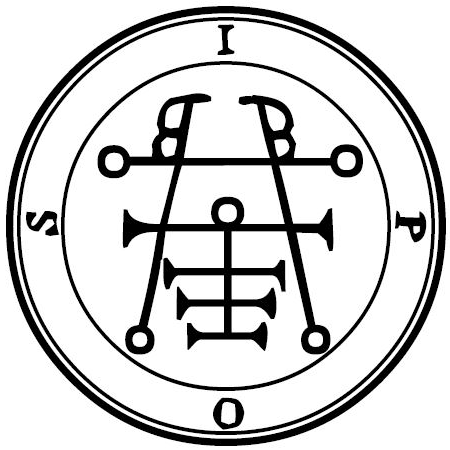
An earl and prince of fire whose dominion encompasses all perceivable things—past and future—and whose wit transforms understanding into weaponized knowledge.
Ipos manifests as a figure of bewildering beauty and shifting form—sometimes appearing as a crowned prince, sometimes as an androgynous being of impossible perfection, sometimes as a shape containing all ages simultaneously. The demon's presence brings the smell of lightning, burning flowers, and electricity before a storm. Those who perceive Ipos experience a sudden flood of information—past and future, visible and hidden—all accessible simultaneously.
The demon's aura crackles with intellectual violence and the sharp edge of perfect wit. Ipos carries no warmth, though great beauty; the demon is simultaneously utterly fascinating and deeply unsettling. The air around Ipos seems to sharpen—senses become acute, words cut more precisely.
Ipos perceives past and future with perfect clarity, seeing all events that have occurred and all likely futures that may unfold. Unlike Botis' understanding of causality, Ipos simply sees—all moments equally present.
The demon grants rhetorical power and argumentative superiority, allowing perception of opponents' logical weaknesses and exploitation with devastating precision. Conversations become contests where the summoner unfailingly identifies flaws.
Ipos commands thirty-six legions of spirits, each bound to carry out the summoner's will with perfect precision. These spirits execute commands with knowledge of all relevant factors.
The emergence of Ipos within the Western grimoire tradition.
Ipos appears in the major European grimoire compilations of the sixteenth and seventeenth centuries, cataloged as the Earl and Prince of the Goetia's infernal hierarchy. The spirit commands 36 legions and holds dominion over matters of grants courage and boldness.
The name Ipos does not appear in pre-medieval sources with certainty, suggesting this spirit may represent a later codification of older folk beliefs about elemental fire spirits, planetary mars intelligences, or localized spirits of place that were systematized during the great period of grimoire compilation.
What is certain is that by the time Johann Weyer published the Pseudomonarchia Daemonum in 1577, Ipos had been assigned a fixed position in the hierarchy, specific powers, and a defined method of conjuration — details that would be refined but largely preserved in the later Ars Goetia.
How different sources describe Ipos across centuries of compilation.
Ipos in art, literature, and the modern imagination.
Historical and modern approaches to working with Ipos.
Regardless of method, the irreducible correspondences remain: the seal is central, the element is Fire, the planet is Mars, the metal is iron, and the day is Tuesday. These form the signal beneath the noise of varying approaches.
Ipos responds to invocations made by those seeking knowledge of consequences and futures, particularly when engaged in complex contests.