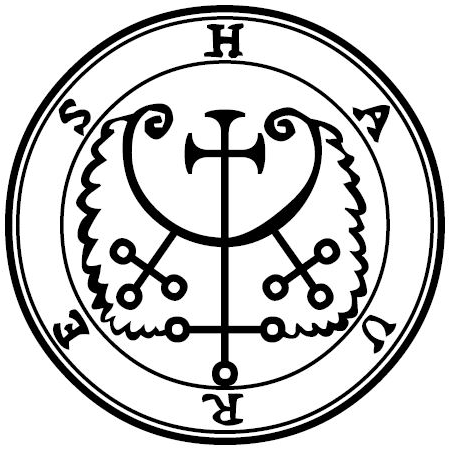
Destroyer of enemies and revealer of past and future, wielding martial power to unmake opposition and expose hidden truths of existence.
Haures manifests as a towering figure with a leopard's head and the body of a muscular warrior wreathed in flame. His form shifts between solid and liquid, sometimes appearing as pure fire held in vaguely humanoid shape. Eyes like molten metal pierce through darkness and deception. The air around him ripples with heat and intention.
His aura radiates absolute confidence and controlled fury. Those in his presence feel simultaneously protected and threatened—his power is palpable, his focus merciless. He sees through all pretense and deception to the raw truth beneath. Reality seems more malleable in his presence, as if time and causality bend to his will.
Targeted destruction of enemies with surgical precision. Unlike Andras's indiscriminate violence, Haures kills only specified targets. However, his power is absolute—protected enemies still fall, and there is no negotiation or mercy once the command is given.
Vision of past events and future trajectories. Haures shows the conjuror what has occurred and what will likely occur. His prophecies are cryptic but accurate—interpreting them requires wisdom. He particularly enjoys showing conjurors futures they fear.
Answers fundamental questions about creation, divinity, and existence's nature. His answers are always true but often philosophically destabilizing. Conjurors sometimes wish they had not asked, as his responses undermine comforting beliefs.
The emergence of Haures within the Western grimoire tradition.
Haures, also known as Flauros or Havres, emerges in late medieval demonological texts as a figure of singular duality: simultaneously a destroyer of enemies and a revealer of hidden knowledge. His classification as a Duke reflects his administrative authority over the infernal armies, commanding 36 legions with precision. The Vulgate demonologies distinguish Haures through his dual nature—he is not merely destructive, but prophetic, capable of unveiling the future while simultaneously burning away opposition to the conjurer.
The leopard form attributed to Haures carries deep symbolic weight within medieval occult tradition. The leopard represents ferocity tempered by cunning, strength combined with vigilance. Medieval bestiaries associated the leopard with revelation and hidden sight; its spotted coat was read as a cipher of hidden truths beneath apparent surfaces. This iconography suggests Haures's essential function: to strip away concealment and expose both enemies and temporal trajectories with unflinching clarity.
A critical distinction emerges in Haures's characterization across sources: he is explicitly noted as a deceiver unless constrained within the triangle. This establishes him as a spirit whose power includes the manipulation of perception itself, making him particularly dangerous to unprepared practitioners. His willingness to lie transforms him into a teacher of discernment—only those capable of recognizing falsehood can effectively work with his prophetic gifts.
How different sources describe Haures across centuries of compilation.
Haures in art, literature, and the modern imagination.
Historical and modern approaches to working with Haures.
Regardless of method, the irreducible correspondences remain: the seal is central, the element is Fire, the planet is Venus, the metal is Copper, and the day is Friday. These form the signal beneath the noise of varying approaches.
Haures responds to righteous anger and genuine need for protection. He dislikes petty vengeance—the target must pose real threat. Response typically within three days. His prophecies often appear first in dreams.