Master of measurement and geometry, granting perception of hidden patterns and mathematical relationships underlying physical reality.
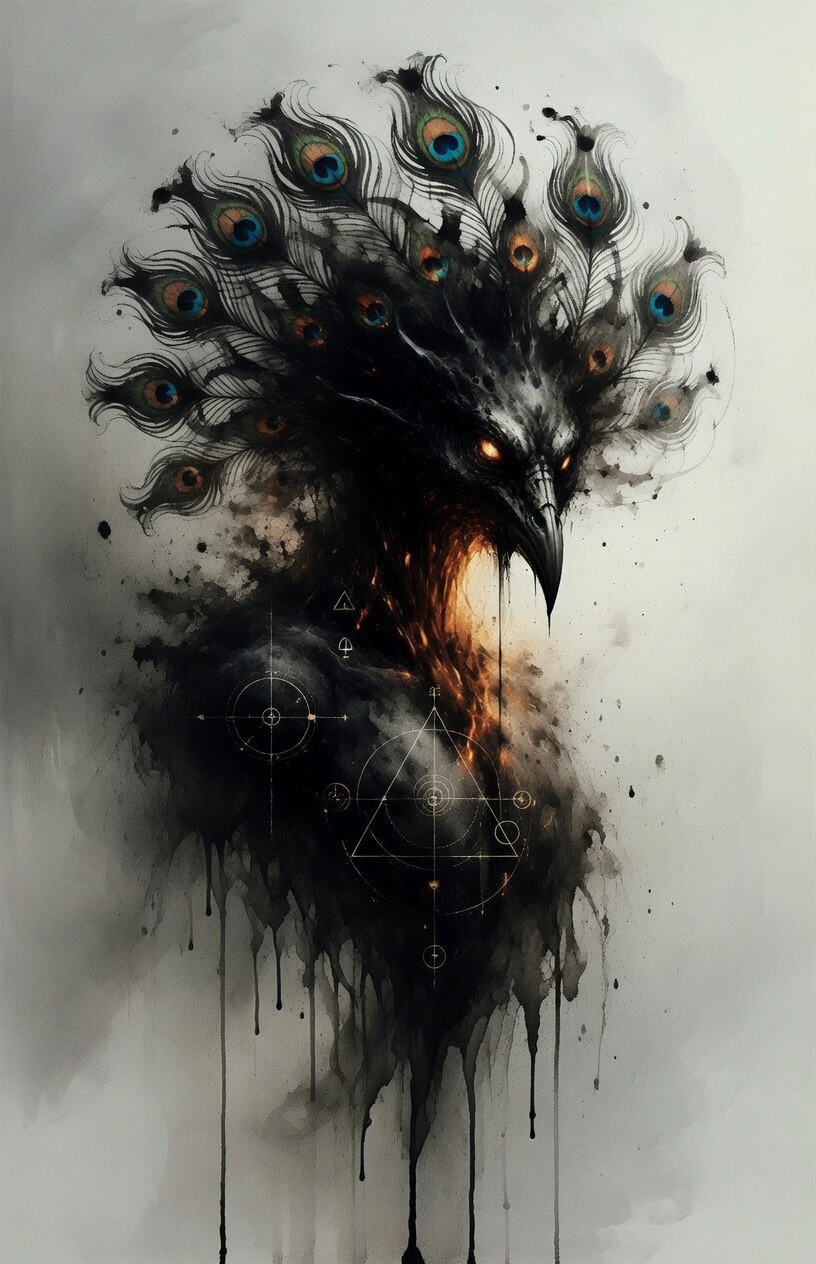
Andrealphus manifests as a figure with a peacock's head, body composed of geometric light-forms constantly shifting. Surrounded by rotating mathematical symbols—triangles, circles, complex polyhedra.
His aura radiates perfect order and hidden design. Those perceive mathematical relationships underlying all things—golden ratio in natural forms, harmonic intervals in sound, precise geometries of crystals.
Sacred geometry underlying creation. Mathematical principles governing growth, form, transformation.
Perfect measurement and calculation. Absolute accuracy in surveying, construction, navigation.
Physical transformation through geometric understanding. Changes animal appearances by adjusting proportions.
The emergence of Andrealphus within the Western grimoire tradition.
Andrealphus emerges in Renaissance grimoire tradition as a figure of intellectual precision and geometric revelation, commanding 40 legions under the classification of Marquis. His designation marks him as an instructor in the hidden mathematics governing physical reality, a role rarely attributed to demonic entities in medieval texts. The shift toward geometric and mathematical knowledge in grimoires of the 14th and 15th centuries brought figures like Andrealphus into prominence—spirits capable of unveiling the underlying numerical patterns of creation itself.
The peacock remains Andrealphus's singular and most distinctive form across all traditions. Medieval natural philosophy associated the peacock with geometry itself—its tail feathers display mathematical perfection in their arrangement, a fact medieval scholars attributed to divine design. The peacock's cry, described in medieval texts as supremely loud and piercing, connects to Andrealphus's announced appearance through great noise, suggesting that knowledge of hidden patterns makes itself known through sound and signal. His subsequent transformation into human form represents the translation of cosmic geometry into human comprehension.
A crucial aspect of Andrealphus's historical presence involves his capacity for transformation—teaching men to assume the form of birds. This power suggests his dominion extends beyond geometry into metamorphosis itself, implying that understanding the deep structure of reality grants power to alter apparent form. His pedagogical function marks him as one of the few genuinely instructional spirits, whose primary concern is transmission of knowledge rather than granting material benefits.
How different sources describe Andrealphus across centuries of compilation.
Andrealphus in art, literature, and the modern imagination.
Historical and modern approaches to working with Andrealphus.
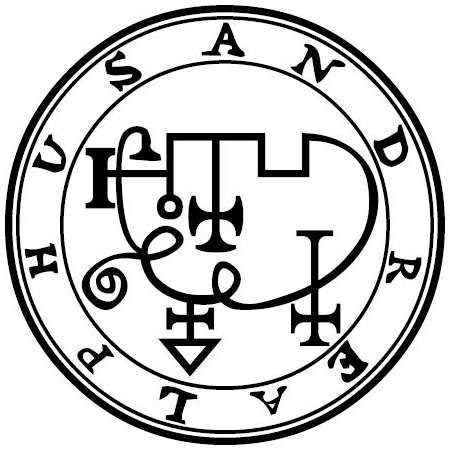
Regardless of method, the irreducible correspondences remain: the seal is central, the element is Air, the planet is the Moon, the metal is Silver, and the day is Monday. These form the signal beneath the noise of varying approaches.
Responds to genuine curiosity about pattern and design. Dislikes destructive applications. Response within three lunar cycles.