No. 63 — Marquis

Andras

Bringer of discord and destruction, severing bonds and ending conflict through violent means—to be approached with utmost caution.

Andras — manifestation

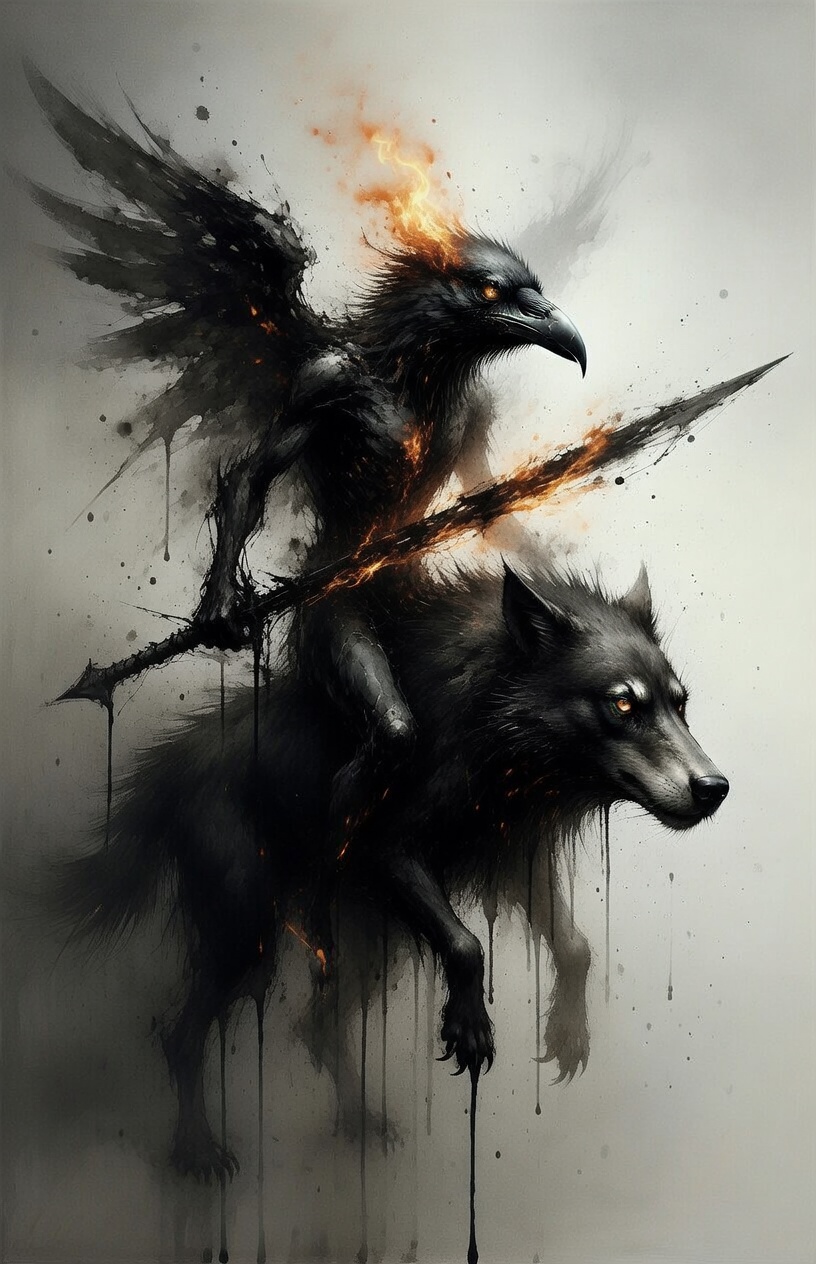
Andras manifests as a towering figure with the head and wings of a magnificent raven, his body wrapped in crackling flame and wreathed in smoke. He rides upon a black wolf whose eyes burn with malice. His presence fills space with palpable menace—walls seem to close in, the temperature drops despite surrounding fire, and the air tastes of iron and ash.

His aura radiates pure Mars energy: aggression, discord, and the breaking of established bonds. Those in his presence feel sudden anger, old grievances resurface, and hidden resentments become unbearably present. Relationships splinter without direct action—merely his presence sows division and conflict in groups.

Powers
Sowing Discord
Creates conflict, jealousy, and anger between previously friendly parties. Works through manipulation of existing tensions rather than creating wholly new hostility.
Assassination
Brings death to the conjuror's enemies. However, Andras is profoundly dangerous—many historical accounts record him killing the conjuror and their servants alongside intended targets.
Bond-Breaking
Severs relationships, partnerships, alliances, and magical bindings. Completely dissolves connection between previously connected parties.
Violent Transformation
Converts circumstances through force and destruction. What cannot be reformed must be demolished—Andras makes no distinction between the two.
Rank
Marquis
Legions
36
Sphere
Moon
Element
Fire
South / Noon
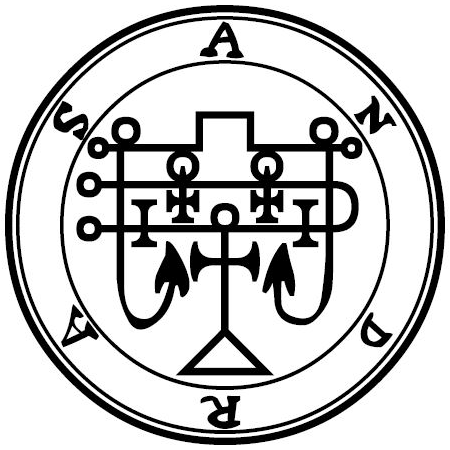
Seal
See Grimoire
Notation Below
Seal of Andras
Powers & Dominion 3 recorded abilities
01 Discordia Mortalis

Induces fatal conflict between enemies without requiring direct violence. Manipulates circumstances, misunderstandings, and old grudges until conflict becomes inevitable and lethal. Most dangerous power—once released, almost impossible to control or redirect.

destruction conflict danger
02 Interfectio

Direct killing through supernatural means. Appears in historical records as shadow-poison, sudden illness, and inexplicable death. This power requires Andras's direct involvement and is rarely granted—he demands significant sacrifice and accepts only when destruction aligns with his demonic will.

death violence forbidden
03 Solutio Vinculorum

Unbinds all contracts, oaths, and magically-reinforced relationships. Used carefully, this power frees conjuror from disadvantageous agreements. Used recklessly, it severs beneficial bonds alongside harmful ones—often with catastrophic consequences.

severance breaking release
Deep Lore
I.

Historical Origins

The emergence of Andras within the Western grimoire tradition.

Andras emerges in medieval demonological texts as an instrument of severance and violent rupture, first catalogued in the German grimoires of the 15th century where he bears the glyph of discord. His classification as a Marquis reflects his perceived rank among the hierarchies of destruction—a demonic lord whose singular dominion extends over the shattering of bonds, both social and spiritual. Medieval theologians distinguished Andras from mere destructive entities by his specificity: he does not simply destroy, but engineers the psychological and social fracture that precedes annihilation.

The iconography of Andras—an angel's visage coupled with a raven's head, mounted upon a black wolf with sword drawn—carries deliberate inversions of Christian symbolism. The angel's form invokes the corrupted nature of rebellion itself, while the raven references classical associations with battle-frenzy and prophecy. This hybrid form recurs throughout medieval grimoires with striking consistency, suggesting a continuous transmission from a single authoritative source, perhaps an earlier demonological catalog now lost to history.

Andras occupies a unique position among the 72 spirits: his danger is not merely theoretical but actively warned against by grimoire compilers. Unlike demons bound by oath to serve the conjurer, Andras is characterized as actively antagonistic, capable of turning his power against the practitioner should any element of the ritual falter. This distinction elevates him into the category of genuinely perilous entities, approached only by practitioners with profound understanding of containment and binding.

c. 1450s
German Grimoire Codices
Andras appears in the earliest known German demonological manuscripts, where he is listed as a Marquis commanding 36 legions and bearing explicit warnings against careless conjuration.
1577
Pseudomonarchia Daemonum
Weyer classifies Andras within the infernal hierarchy and emphasizes his dominion over discord and enmity, noting his capacity for destruction of both enemies and allies alike.
c. 1600s
The Ars Goetia
Andras is listed as the 63rd spirit of the Lesser Key, with additional notation regarding the extreme caution required during invocation and the danger posed to the operator.
1818–1863
Dictionnaire Infernal
De Plancy reinforces Andras's reputation as a principally destructive force, associating him with violent severance of relationships and the corruption of trust.
II.

Grimoire Variations

How different sources describe Andras across centuries of compilation.

Ars Goetia
Lesser Key of Solomon · c. 1600s
A Marquis appearing as an angel with a raven's head, sitting upon a black wolf and carrying a sharp sword. Commands 36 legions. Sows discord among men and destroys the conjurer if insufficient precaution is taken.
The Ars Goetia emphasizes Andras's danger and the necessity of absolute ritual precision, distinguishing him from other spirits through explicit warnings.
Pseudomonarchia Daemonum
Johann Weyer · 1577
Andras is known as a Marquis of 36 legions, appearing as a demonic angel mounted upon a wolf, skilled in the dissolution of bonds and the engineering of enmity between previously allied parties.
Weyer's classification emphasizes Andras's function as a deliberate instrument of social chaos rather than mere destruction.
Dictionnaire Infernal
Collin de Plancy · 1818 / 1863
Andras remains classified among the most dangerous spirits, his power extending specifically to the severing of relationships, corruption of trust, and the violent destruction of both persons and bonds.
De Plancy's later treatment affirms Andras's consistently perilous nature across centuries of demonological tradition.
III.

Cultural Legacy

Andras in art, literature, and the modern imagination.

Grimoire Tradition
The Raven-Headed Severance
Andras has maintained consistent iconography across five centuries of grimoire transmission, his hybrid form representing the perversion of divine authority. The raven's head specifically marks him as a guide through spiritual death and severance, linking him to Odinic traditions of knowledge gained through sacrifice and dissolution.
RUPTURE
DISCORD
Modern Practice
Strategic Dissolution
Contemporary practitioners approach Andras with specialized intent: the ending of cycles, the severing of toxic bonds, and the deliberate engineering of necessary conflict. His danger is paradoxically his utility—only those who understand dissolution as a form of transformation can work with him safely.
Games & Media
The Destroyer of Truces
Andras appears in modern occult fiction and gaming as the embodiment of chaos unleashed, often invoked inadvertently by those seeking merely to harm enemies without understanding the scope of his destructive capacity. His raven-headed form recurs in contemporary demonological art as a symbol of inevitable entropy.
VOID
IV.

Ritual Traditions

Historical and modern approaches to working with Andras.

01
Solomonic Ceremonial
Traditional Solomonic practice requires a triple circle, iron binding glyphs, and the explicit invocation of constraint before Andras is named. The seal must be worn as protection; the operator stands within the innermost circle while calling the spirit into the triangle. Correspondences: lunar force governs the calling; silver amplifies constraint; Monday provides the temporal window of weakest power.
02
Grimoire Purist
The strictly literal approach follows the Lesser Key protocols without deviation: the operator must possess absolute clarity of intent before invocation, as ambiguity opens vulnerability. The sword or knife becomes the instrument of banishment, mirroring Andras's own weaponry. Any hesitation in command is interpreted as weakness and exploited.
03
Psychological Model
Modern practitioners treating Andras as an archetypal principle invoke him as the internal dissolver of false securities and corrupted bonds. This approach frames his power as the necessary destruction preceding transformation, working with his force rather than against it. Integration rather than domination becomes the goal.
04
Modern Devotional
Contemporary practitioners approaching Andras as ally rather than threat develop ongoing relationships through offerings and acknowledgment. The raven remains sacred to him; some leave food at liminal spaces. This relationship requires radical honesty about intentions, as Andras responds to deception with swift retribution.

Regardless of method, the irreducible correspondences remain: the seal is central, the element is Fire, the planet is the Moon, the metal is Silver, and the day is Monday. These form the signal beneath the noise of varying approaches.

Classification
RankMarquis — sovereign authority
Legions36 — spirits under direct command
PlanetMoon — ☽
MetalSilver — Ag
ElementFire
SummoningMonday
SealRequired — inscribed on lamen or parchment
Invocation
Andras, raven-winged and fierce,
Through fire and fury make thy pierce,
Break bonds of those who wish us ill,
But spare us from thy darker will.

CRITICAL WARNING: Andras is among the most dangerous demons. Many conjurors invoking him have been killed alongside their intended targets. Invoke only in genuine extremity and with elaborate protective measures. Response is swift and indiscriminate.

← Previous
Valac
No. 62 — President
Explore
Lore
History & Origins
Next →
Haures
No. 64 — Duke