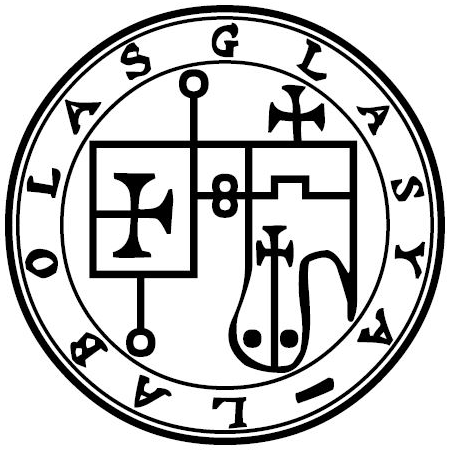
President and Earl commanding 36 legions, master of bloodshed, divination, and invisibility through fire and Mars.
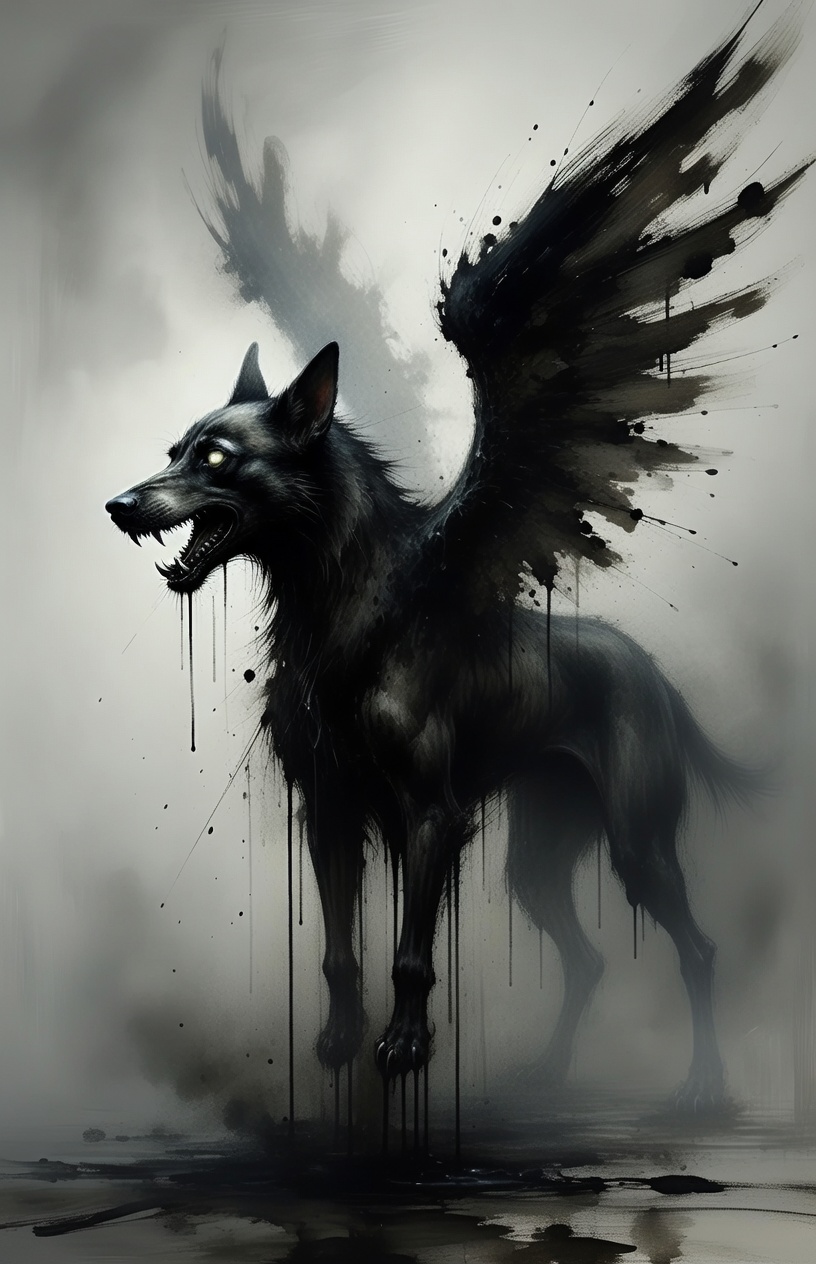
Glasya-Labolas manifests as a luminous hound wreathed in sacred flames, his form shifting between canine and humanoid. His eyes burn with prophetic fire, reflecting the blood of battles yet to come. Iron chains coil around his shoulders like living serpents. Where he walks, the air crackles with Mars-touched energy, and the smell of forge-fire and rust permeates the space.
His presence radiates intense heat and a palpable hunger for conflict. Those near him feel compelled toward clarity of purpose, yet the weight of consequence bears heavily. A faint howl echoes beneath his words—the ancient cry of warriors and hunters calling to their deepest instincts.
Grants profound insight into conflict dynamics, allowing the practitioner to perceive true intentions and hidden threats. Enhances tactical awareness and decisiveness in moments of crisis.
Wraps the practitioner in shadow-fire, a paradoxical veil that obscures sight while maintaining purposeful action. Useful for intelligence gathering and covert operations.
Opens channels to prophetic knowledge of coming violence and bloodshed. Often used by warrior-sages and mercenaries seeking advantage in armed conflict.
The emergence of Glasya-Labolas within the Western grimoire tradition.
Glasya-Labolas appears in the major European grimoire compilations of the sixteenth and seventeenth centuries, cataloged as the President and Earl of the Goetia's infernal hierarchy. The spirit commands 36 legions and holds dominion over matters of teaches sciences and hidden secrets.
The name Glasya-Labolas does not appear in pre-medieval sources with certainty, suggesting this spirit may represent a later codification of older folk beliefs about elemental air spirits, planetary mercury intelligences, or localized spirits of place that were systematized during the great period of grimoire compilation.
What is certain is that by the time Johann Weyer published the Pseudomonarchia Daemonum in 1577, Glasya-Labolas had been assigned a fixed position in the hierarchy, specific powers, and a defined method of conjuration — details that would be refined but largely preserved in the later Ars Goetia.
How different sources describe Glasya-Labolas across centuries of compilation.
Glasya-Labolas in art, literature, and the modern imagination.
Historical and modern approaches to working with Glasya-Labolas.
Regardless of method, the irreducible correspondences remain: the seal is central, the element is Air, the planet is Mercury, the metal is mercury, and the day is Wednesday. These form the signal beneath the noise of varying approaches.
Glasya-Labolas responds swiftly to those calling during dawn or dusk—liminal times of conflict and transition. He favors martial practitioners, strategists, and those seeking hidden knowledge of coming strife.