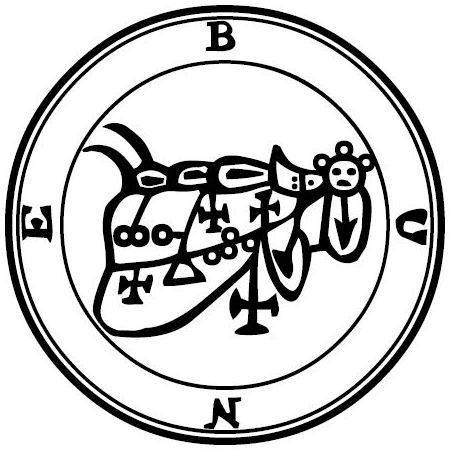
Duke commanding 30 legions, master of wealth, eloquence, and the movement of the dead through Saturn's earthen influence.
Bune manifests as a towering figure draped in deep purple and grey, his form suggesting both immense dragon-wings and a nobleman's ancient robes. His voice carries the weight of millennia—each word lands with the gravity of stone. Golden coins rain from his fingers like water, yet they vanish before touching ground. The earth itself seems to listen when he speaks, as stones crack subtly in acknowledgment of his presence.
A profound heaviness accompanies Bune—not threat, but the inexorable weight of Saturn's influence. Those in his presence feel the passage of time, the accumulation of wealth and loss across generations. His aura suggests both abundance and ruin, creation and decay existing in perfect balance.
Opens pathways to unexpected wealth and prosperity. Bune reveals investment opportunities, hidden resources, and financial solutions that appear impossible. Works through intuition and timely encounters.
Grants the speaker absolute presence and persuasive power. Words carry conviction and authority; listeners find themselves compelled to agree or assist. Essential for negotiation and leadership.
Enables the practitioner to speak with and direct spirits of the dead. Useful for resolving unfinished business, gathering wisdom from ancestors, or understanding family patterns and inherited knowledge.
The emergence of Bune within the Western grimoire tradition.
Bune appears in the major European grimoire compilations of the sixteenth and seventeenth centuries, cataloged as the Duke of the Goetia's infernal hierarchy. The spirit commands 36 legions and holds dominion over matters of reveals treasures and commands ghosts.
The name Bune does not appear in pre-medieval sources with certainty, suggesting this spirit may represent a later codification of older folk beliefs about elemental earth spirits, planetary venus intelligences, or localized spirits of place that were systematized during the great period of grimoire compilation.
What is certain is that by the time Johann Weyer published the Pseudomonarchia Daemonum in 1577, Bune had been assigned a fixed position in the hierarchy, specific powers, and a defined method of conjuration — details that would be refined but largely preserved in the later Ars Goetia.
How different sources describe Bune across centuries of compilation.
Bune in art, literature, and the modern imagination.
Historical and modern approaches to working with Bune.
Regardless of method, the irreducible correspondences remain: the seal is central, the element is Earth, the planet is Venus, the metal is copper, and the day is Friday. These form the signal beneath the noise of varying approaches.
Bune responds to invocations conducted at dusk or in graveyards, particularly near tombs of the prosperous or influential. He favors those with genuine business acumen and respect for both the living and the dead.