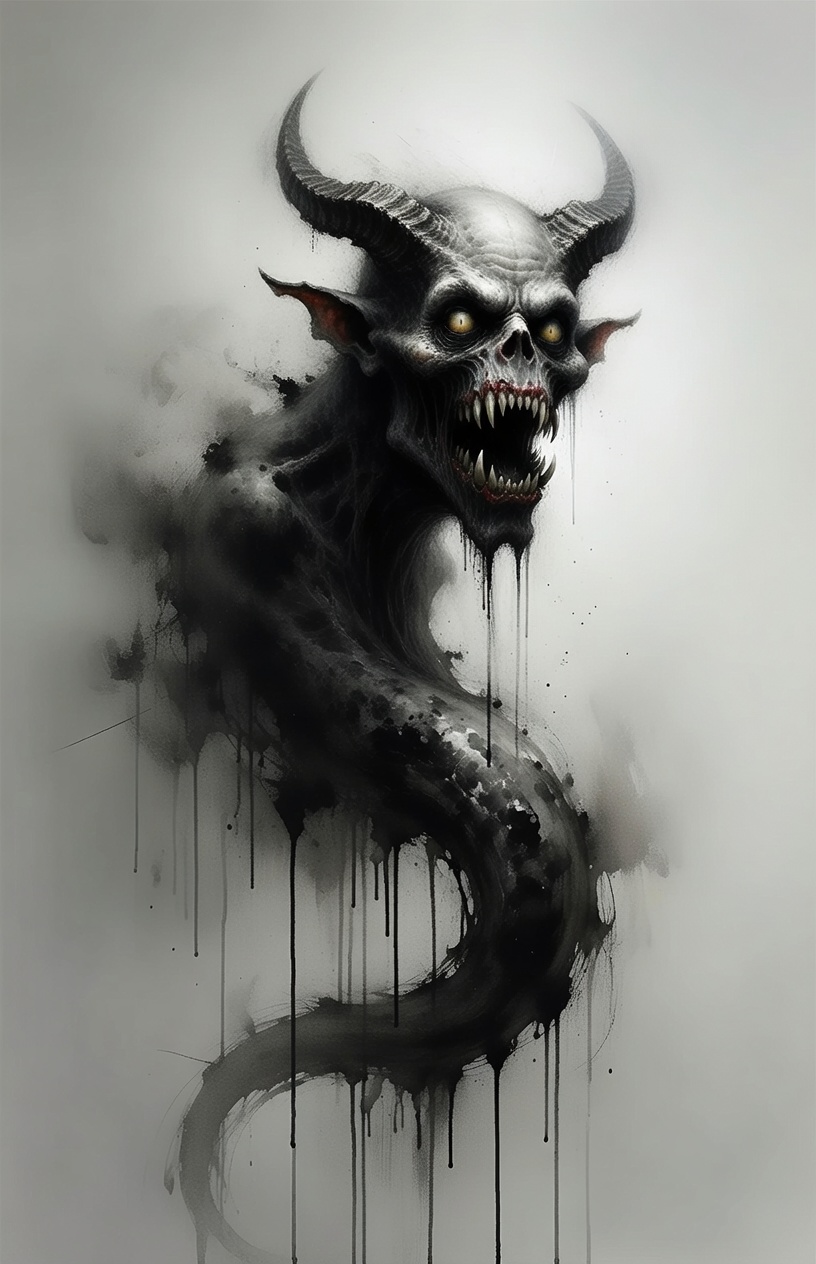
A president and earl of the air who perceives past and future simultaneously, reconciles what was broken, and bridges all temporal divisions.
Botis manifests as a figure existing simultaneously in multiple moments—appearing old and young, alive and spectral, present and distant. Some witnesses describe seeing several slightly-offset versions of Botis occupying the same space, their forms overlapping like photographs exposed multiple times. The demon's voice carries echoes of conversations not yet spoken and words already forgotten. The air around them smells of old libraries, rust, and the peculiar ozone scent that precedes both thunderstorms and temporal shifts.
Those in Botis' presence experience disorientation regarding causality—events seem to occur before their causes manifest, consequences arrive before their origins. Yet paradoxically, perfect clarity often accompanies this disorientation; the temporal confusion somehow grants insight into how past, present, and future interconnect and influence one another.
Botis perceives past, present, and future as a unified field, seeing how present circumstances arose from past choices and will determine future outcomes. This perception grants clarity regarding causality, consequence, and the hidden patterns that shape events.
By revealing the true history underlying conflicts, Botis facilitates reconciliation between estranged parties. The demon does not force agreement but rather grants each party understanding of how the conflict arose and what misunderstandings perpetuate it.
Botis commands sixty legions of air-spirits, each capable of carrying information across time, communicating with those long dead, and accessing knowledge from moments past and future. These spirits serve as messengers, historians, and prophets.
The emergence of Botis within the Western grimoire tradition.
Botis appears in the major European grimoire compilations of the sixteenth and seventeenth centuries, cataloged as the President and Earl of the Goetia's infernal hierarchy. The spirit commands 60 legions and holds dominion over matters of reconciles enemies and reveals hidden things.
The name Botis does not appear in pre-medieval sources with certainty, suggesting this spirit may represent a later codification of older folk beliefs about elemental air spirits, planetary mercury intelligences, or localized spirits of place that were systematized during the great period of grimoire compilation.
What is certain is that by the time Johann Weyer published the Pseudomonarchia Daemonum in 1577, Botis had been assigned a fixed position in the hierarchy, specific powers, and a defined method of conjuration — details that would be refined but largely preserved in the later Ars Goetia.
How different sources describe Botis across centuries of compilation.
Botis in art, literature, and the modern imagination.
Historical and modern approaches to working with Botis.
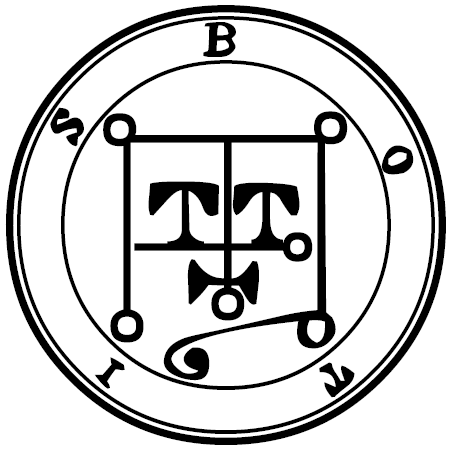
Regardless of method, the irreducible correspondences remain: the seal is central, the element is Air, the planet is Mercury, the metal is mercury, and the day is Wednesday. These form the signal beneath the noise of varying approaches.
Botis responds most readily to those seeking genuine understanding rather than mere information, and to invocations made during twilight when day transitions to night.