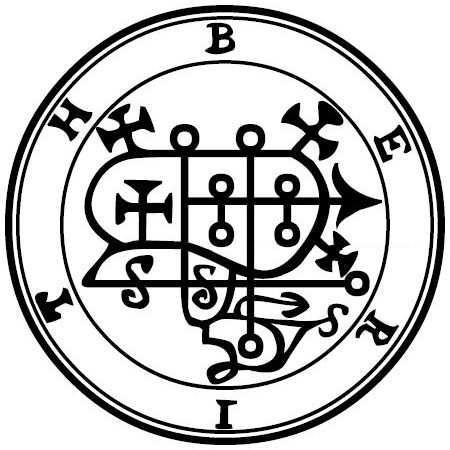
Duke commanding 26 legions, master of alchemy and transmutation—turning base metals to gold through Mars-fire and ancient covenant.
Berith manifests as a beautiful warrior-king wreathed in red and golden flame, his armor forged from unknown metals that shift and shimmer. His face is noble yet dangerous—a prince of fire who speaks with absolute authority. Red-hot chains coil around his throne-like seat, not binding but adorning his power. The air around him smells of sulfur and molten gold; the sound of a forge underlies every word he speaks.
His presence radiates intense heat and the weight of ancient covenant. Those near Berith feel the pressure of transformation—the sense that fundamental change is imminent. His aura suggests both creative fire and destructive potential; he is both the alchemist and the apocalypse.
Unlocks the secrets of transformation—from lead to gold, ignorance to wisdom, weakness to strength. Berith teaches both literal alchemical processes and metaphorical transmutation of human nature and circumstance.
Creates oaths and agreements of absolute power. Any covenant made under Berith's influence becomes unbreakable and eternally binding. Useful for serious commitments and magical contracts.
Manifests literal or metaphorical gold—wealth, success, and precious outcomes. Those who work with Berith's alchemy often find unexpected prosperity and the transformation of valueless effort into precious results.
The emergence of Berith within the Western grimoire tradition.
Berith appears in the major European grimoire compilations of the sixteenth and seventeenth centuries, cataloged as the Duke of the Goetia's infernal hierarchy. The spirit commands 29 legions and holds dominion over matters of transmutes metals and brings honor.
The name Berith does not appear in pre-medieval sources with certainty, suggesting this spirit may represent a later codification of older folk beliefs about elemental fire spirits, planetary venus intelligences, or localized spirits of place that were systematized during the great period of grimoire compilation.
What is certain is that by the time Johann Weyer published the Pseudomonarchia Daemonum in 1577, Berith had been assigned a fixed position in the hierarchy, specific powers, and a defined method of conjuration — details that would be refined but largely preserved in the later Ars Goetia.
How different sources describe Berith across centuries of compilation.
Berith in art, literature, and the modern imagination.
Historical and modern approaches to working with Berith.
Regardless of method, the irreducible correspondences remain: the seal is central, the element is Fire, the planet is Venus, the metal is copper, and the day is Friday. These form the signal beneath the noise of varying approaches.
Berith responds to invocations during twilight hours or midnight—times of transformation and deep work. He favors those making serious commitments, alchemists, and those genuinely engaged in self-transmutation through discipline and fire.