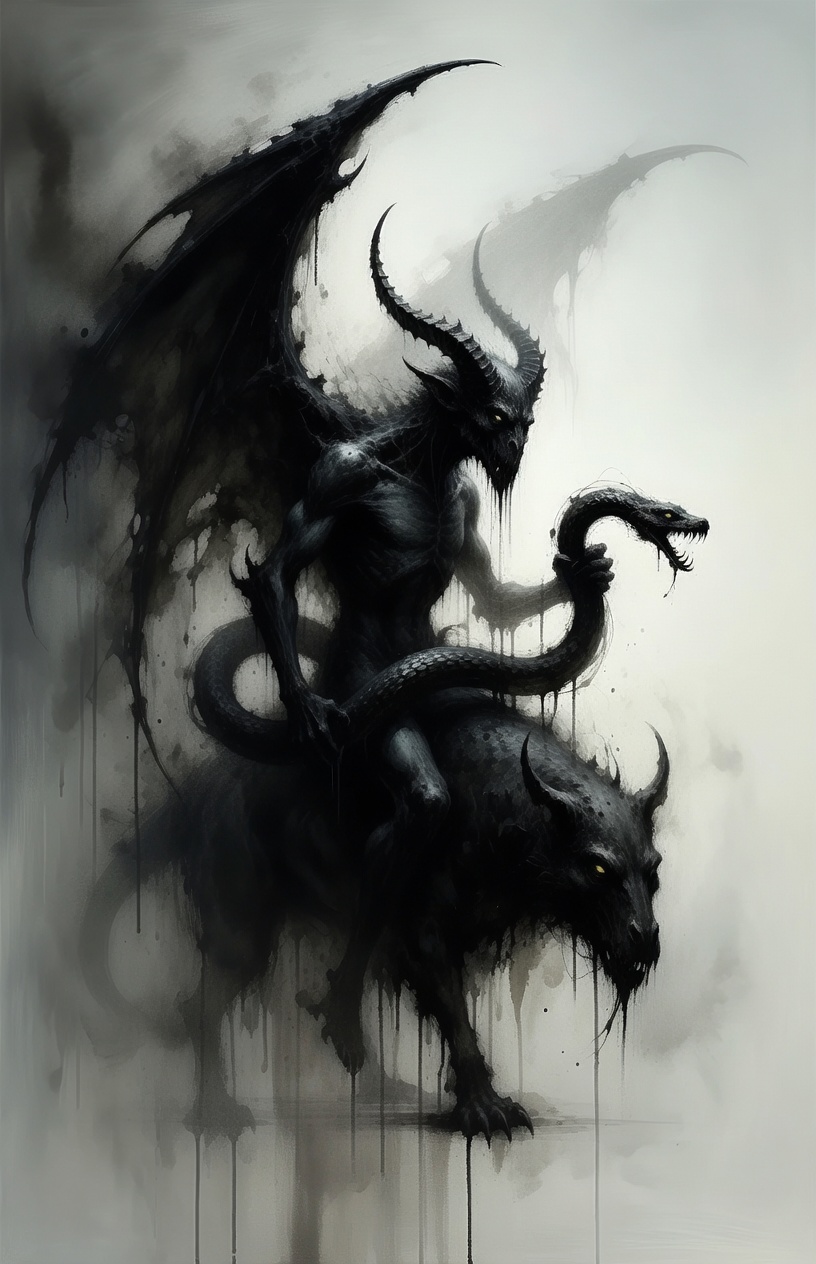
Duke commanding 40 legions, master of past and future knowledge, liberal arts, and wisdom—deriving from ancient Astarte through Saturn's eternal gaze.
Astaroth manifests as a being of profound beauty and terrible wisdom—neither fully male nor female, ancient yet eternally young. She appears sometimes as a golden-haired queen in flowing robes, sometimes as an austere sage with eyes holding all of history. A serpent of green-gold coils around her form, not threatening but eternally present. The air grows thick with knowledge when she manifests; libraries seem to open in the mind. The smell of incense and old parchment surrounds her, mixed with the copper scent of ancient coins.
Astaroth's presence carries the weight of ages and absolute knowledge. Those near her feel simultaneously enlightened and humbled—as though standing before a teacher who sees through all pretense into the core of being. Her aura suggests both nurturing wisdom and stern judgment; she is both mother and oracle, creator and destroyer of illusion.

Astaroth grants sight of past events and future probabilities with remarkable clarity. She reveals hidden histories, forgotten truths, and the genuine consequences flowing from present choices. Visions come through dreams and meditation.
All intellectual disciplines open effortlessly to those favored by Astaroth. Mathematics, language, music, science, and philosophy become accessible and comprehensible. She teaches through dreams, sudden understanding, and chance encounters with crucial texts.
Reveals the true nature of any situation, person, or teaching. Deception becomes impossible in her presence; lies unmask themselves. She teaches discernment and the wisdom to recognize truth from falsehood.
The emergence of Astaroth within the Western grimoire tradition.
Astaroth appears in the major European grimoire compilations of the sixteenth and seventeenth centuries, cataloged as the Duke of the Goetia's infernal hierarchy. The spirit commands 40 legions and holds dominion over matters of reveals hidden secrets of the world.
The name Astaroth does not appear in pre-medieval sources with certainty, suggesting this spirit may represent a later codification of older folk beliefs about elemental water spirits, planetary venus intelligences, or localized spirits of place that were systematized during the great period of grimoire compilation.
What is certain is that by the time Johann Weyer published the Pseudomonarchia Daemonum in 1577, Astaroth had been assigned a fixed position in the hierarchy, specific powers, and a defined method of conjuration — details that would be refined but largely preserved in the later Ars Goetia.
How different sources describe Astaroth across centuries of compilation.
Astaroth in art, literature, and the modern imagination.
Historical and modern approaches to working with Astaroth.
Regardless of method, the irreducible correspondences remain: the seal is central, the element is Water, the planet is Venus, the metal is copper, and the day is Friday. These form the signal beneath the noise of varying approaches.
Astaroth responds to those calling with genuine desire for knowledge and wisdom. She favors scholars, artists, philosophers, and seekers of truth. She appears most readily during times of study, in libraries, and during moments of genuine intellectual hunger. Her responses often come through dreams over several nights.