No. 06 — Duke

Valefor

Master of theft and cunning, granting invisibility and acquisition of desired objects through stealth, disguise, and sympathetic manipulation.

Valefor — manifestation

Valefor manifests as a sleek, shadowed figure, often appearing as a lion or a thief in dark garments. His presence arrives with the scent of smoke and copper, and sudden awareness that the boundary between possession and non-possession is far more permeable. When invoked, those nearby experience uncanny luck—objects become easy to obtain, attention slides away at convenient moments, property boundaries seem strangely negotiable.

His aura crackles with suppressed energy and misdirection. There exists an almost playful quality, though carrying danger—the ease of a predator confident in prowess. Those in his presence feel both more clever and more vulnerable, as though usual rules of consequence have become temporarily suspended. Glances slide past; intentions become obscure; timing aligns with uncanny precision.
Powers
THIEF
Grants invisibility, stealth, and ability to take desired objects undetected
CONJURER
Provides charm, persuasion, and manipulation of attention and desire
TRANSFORMER
Enables change of appearance and assumption of false identities
BINDER
Locks familiars and spirit-servants into compulsory service
Rank
Duke
Legions
10
Sphere
Venus
Element
Fire
South / Noon
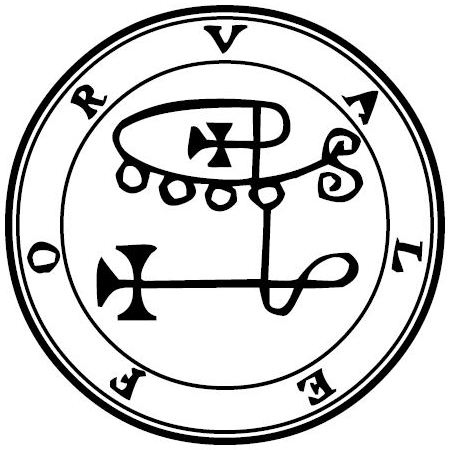
Seal
See Grimoire
Notation Below
Seal of Valefor
Powers & Dominion 3 recorded abilities
01 Theft & Acquisition

Valefor grants both literal and sympathetic theft—the ability to take physical objects undetected and acquire intangible things through cunning: attention, affection, opportunity, information. Power operates through misdirection and manipulation of attention itself; the target becomes literally unable to perceive what is being taken. This extends to stealing back lost things and acquiring from those who guard possessions carefully.

theft cunning acquisition
02 Charm & Persuasion

The spirit confers an almost magnetic quality—the ability to make oneself agreeable, to cause others to lower their guard, to inspire desire for favors. This is not coercive but exploits natural human tendency toward attraction and deference. Those under Valefor's influence find themselves behaving counter to usual judgment, granting things they intended to withhold.

charm persuasion desire
03 Identity Assumption & Disguise

Beyond surface disguise, Valefor teaches the deep art of becoming another—adopting not merely appearance but mannerism, thought-pattern, and social credential. This magic operates at the level of attention and assumption; observers literally perceive the false identity because they expect to. Power is particularly potent in crowds and among those predisposed to see what they anticipate.

disguise deception transformation
Deep Lore
I.

Historical Origins

The emergence of Valefor within the Western grimoire tradition.

Valefor appears in the major European grimoire compilations of the sixteenth and seventeenth centuries, cataloged as the Duke of the Goetia's infernal hierarchy. The spirit commands 10 legions and holds dominion over matters of causes theft and discord.

The name Valefor does not appear in pre-medieval sources with certainty, suggesting this spirit may represent a later codification of older folk beliefs about elemental fire spirits, planetary venus intelligences, or localized spirits of place that were systematized during the great period of grimoire compilation.

What is certain is that by the time Johann Weyer published the Pseudomonarchia Daemonum in 1577, Valefor had been assigned a fixed position in the hierarchy, specific powers, and a defined method of conjuration — details that would be refined but largely preserved in the later Ars Goetia.

c. 1500s
Early Grimoire Appearances
Valefor appears in manuscript traditions circulating among European magical practitioners, though exact dates of first inclusion remain debated.
1577
Pseudomonarchia Daemonum
Johann Weyer includes Valefor in his systematic catalog of infernal spirits, establishing the demon's rank, legions, and primary powers.
c. 1600s
The Ars Goetia
The anonymous compilation that becomes the canonical source fixes Valefor's position as number 6 in the hierarchy of seventy-two, with refined descriptions of appearance and powers.
1818–1863
Dictionnaire Infernal
Collin de Plancy's encyclopedia brings Valefor to a wider audience, though with varying degrees of embellishment and artistic interpretation.
II.

Grimoire Variations

How different sources describe Valefor across centuries of compilation.

Ars Goetia
Lesser Key of Solomon · c. 1600s
Valefor is the Duke of the Goetia, commanding 10 legions of spirits. Valefor tempts the unwary to larceny and theft, inspiring audacious theft and cunning deception in those he favors. He also serves as a willing familiar for magicians, binding himself to a single conj.
The canonical source. Establishes Valefor's position as number 6 in the hierarchy and defines the primary powers that subsequent sources would reference.
Pseudomonarchia Daemonum
Johann Weyer · 1577
Weyer's earlier catalog describes Valefor with similar attributes but often provides additional practical details about the spirit's temperament and the conditions required for successful conjuration.
Weyer's text predates the Ars Goetia and served as one of its primary sources. Differences between the two versions reveal how the tradition evolved over decades of transmission.
Dictionnaire Infernal
Collin de Plancy · 1818 / 1863
De Plancy's encyclopedia entry for Valefor draws primarily from the Ars Goetia but adds editorial commentary and, in the 1863 edition, an accompanying illustration by Louis Le Breton.
De Plancy's contribution is primarily visual and editorial — his encyclopedia brought these spirits to a general audience for the first time, framed as objects of scholarly curiosity rather than practical conjuration.
III.

Cultural Legacy

Valefor in art, literature, and the modern imagination.

Grimoire Tradition
The Duke in the Western Magical Canon
Valefor occupies a specific niche in the Western magical tradition as a spirit of fire, governed by Venus and associated with copper. These correspondences place Valefor within a coherent cosmological framework that practitioners have used for centuries to understand and engage with the spirit world.
TAKE
THIEF
Modern Practice
Contemporary Engagement
In modern occult practice, Valefor is approached through multiple frameworks — from traditional Solomonic ceremonial magick to psychological models that treat the demon as an archetype of causes theft and discord. The spirit's domain over fire and connection to Venus inform the timing and methods practitioners use.
Games & Media
Digital Afterlife
Like many spirits of the Goetia, Valefor appears across video games, tabletop RPGs, and fantasy literature — the Ars Goetia serving as one of gaming's most reliable bestiaries. Each adaptation preserves the core attributes while recontextualizing them for new audiences and media.
LION
IV.

Ritual Traditions

Historical and modern approaches to working with Valefor.

01
Solomonic Ceremonial
The classical method requires a circle of protection, Valefor's seal inscribed on a lamen worn over the heart, and conjuration through graduated orations. The magician commands by divine authority, and Valefor appears within a brass triangle. Timing: Friday, during the planetary hour of Venus.
02
Grimoire Purist
Strict adherence to original manuscript instructions — hand-crafted tools, specific materials, precise ritual timing. The argument is that the grimoire's specific procedures create a coherent symbolic language. For Valefor, this means working with copper implements and fire correspondences.
03
Psychological Model
Following the chaos magick tradition, Valefor is approached as an archetype — a personification of the practitioner's own capacity for causes theft and discord. The seal becomes a meditation focus; invocation becomes active imagination. The circle is a psychological boundary.
04
Modern Devotional
A relational approach treating Valefor as an autonomous entity worthy of respect. Practitioners build ongoing relationships through offerings — typically incense, candles, or libations associated with Venus — and regular communication. The seal is displayed on an altar. Valefor is petitioned, not commanded.

Regardless of method, the irreducible correspondences remain: the seal is central, the element is Fire, the planet is Venus, the metal is copper, and the day is Friday. These form the signal beneath the noise of varying approaches.

Classification
RankDuke — sovereign authority
Legions10 — spirits under direct command
PlanetVenus — ♀
MetalCopper — Cu
ElementFire
SummoningFriday
SealRequired — inscribed on lamen or parchment
Invocation
Valefor, keeper of the hidden way,
Who takes what others clutch and hold,
Grant me the charm to turn their stay,
And fortune's touch both swift and bold.

Valefor responds most readily to those operating at the margins of social law—those whose survival depends on cunning and resourcefulness. He favors practitioners who acknowledge transgressive nature rather than pretending virtue.

← Previous
Marbas
No. 05 — President
Explore
Lore
History & Origins
Next →
Amon
No. 07 — Marquis