
President commanding 29 legions, master of logic, ethics, herbalism, and precious stones through Saturn's grounded, methodical power.
Foras manifests as a robed scholar surrounded by gardens and mineral-light—sometimes appearing as an elderly naturalist, sometimes as a younger figure whose eyes hold geological ages. Plants grow vibrant in his presence; stones seem to shimmer with inner knowledge. His form is steady, grounded, and utterly substantial—no wavering, no illusion. The air around him smells of earth after rain, dried herbs, and mineral stone. His presence suggests wisdom earned through patient observation and disciplined study.
Foras's presence radiates trustworthy knowledge and the satisfaction of understanding how things actually work. Those near him feel clarity about natural processes and the logic underlying all phenomena. His aura suggests both gentleness and immovable certainty—the patience of a mountain and the care of a gardener.
Grants perfect clarity in reasoning and argumentation. Complex philosophical and logical problems become clear; fallacies reveal themselves. Foras teaches not abstract logic but the logic embedded in how reality actually functions.
Reveals the properties and uses of all plants and herbs. Foras teaches healing, cultivation, cooking, and medicine through direct knowing. Plant identification becomes intuitive; medicinal and magical uses become obvious.
Opens understanding of minerals, crystals, and precious stones. Foras teaches their properties, locations, and uses. Geological knowledge and crystal-working become accessible to practitioners.
The emergence of Foras within the Western grimoire tradition.
Foras appears in the major European grimoire compilations of the sixteenth and seventeenth centuries, cataloged as the President of the Goetia's infernal hierarchy. The spirit commands 29 legions and holds dominion over matters of reveals treasures and teaches sciences.
The name Foras does not appear in pre-medieval sources with certainty, suggesting this spirit may represent a later codification of older folk beliefs about elemental earth spirits, planetary mercury intelligences, or localized spirits of place that were systematized during the great period of grimoire compilation.
What is certain is that by the time Johann Weyer published the Pseudomonarchia Daemonum in 1577, Foras had been assigned a fixed position in the hierarchy, specific powers, and a defined method of conjuration — details that would be refined but largely preserved in the later Ars Goetia.
How different sources describe Foras across centuries of compilation.
Foras in art, literature, and the modern imagination.
Historical and modern approaches to working with Foras.
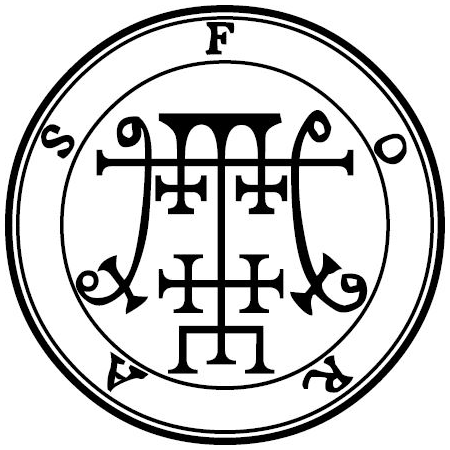
Regardless of method, the irreducible correspondences remain: the seal is central, the element is Earth, the planet is Mercury, the metal is mercury, and the day is Wednesday. These form the signal beneath the noise of varying approaches.
Foras responds to those calling in gardens, forests, or near stone formations. He favors herbalists, naturalists, philosophers, and those engaged in genuine study of natural phenomena. He appears most readily during dawn and responds through dreams and direct knowing that emerges in practice.