Master of invisibility and concealment — renders the petitioner imperceptible to all forms of perception, both mundane sight and magical detection.
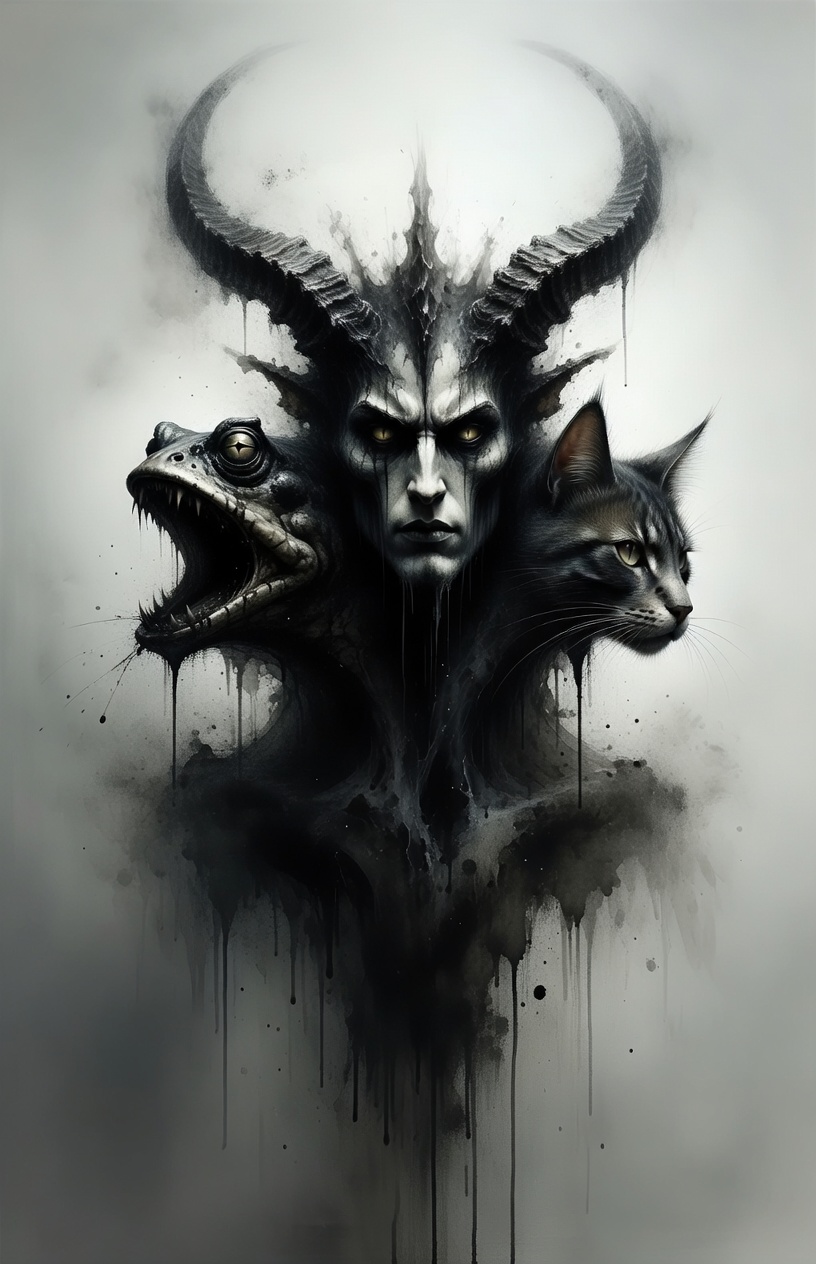
Bael manifests in a perpetually shifting form that defies singular perception — a lithe black cat with knowing golden eyes, a warty toad with pustulent skin, and a robed human figure seem to flicker simultaneously like candlelight reflected in oil.
His presence creates a subtle distortion in the air around him, causing shadows to deepen and colors to mute. When he settles into stillness, only his outline remains certain; the interior of his form seems hollow, a void that invites disappearance.
Grants the supplicant imperceptibility to all forms of perception — rendering the petitioner unseen by mortal eyes and undetected by magical scrying. Neither torch, nor moonlight, nor the inner sight of seers will reveal one shrouded by Bael's power.
Weaves veils of shadow and absence around those who petition him, concealing their true nature, intention, and essence from all forms of detection. Even the most penetrating divination is rendered blind.
Particularly serves those seeking to move unseen through perilous domains — enabling safe passage where danger lurks in every shadow and every eye is an enemy. The traveller becomes as the wind: felt, perhaps, but never caught.
From supreme deity of the ancient world to the first king of Hell — the longest fall in religious history.
Bael did not begin as a demon. He began as a god. The name descends directly from Ba'al — a title meaning "Lord" or "Master" in the Semitic languages of the ancient Near East. For over two thousand years, Ba'al was among the most widely worshipped deities in the Mediterranean world: the Canaanite storm god, rider of clouds, lord of rain and fertility, the force that made crops grow and kingdoms prosper.
At Ugarit, the great Bronze Age city on the Syrian coast, Ba'al Hadad sat at the center of the pantheon. The Ugaritic texts — clay tablets preserved since roughly 1200 BCE — describe his cosmic battles against Yam, the sea god, and Mot, the god of death. He dies. He returns. The rains come again. This is not a minor spirit. This is the engine of the world.
The Phoenicians carried his worship across the Mediterranean. Ba'al Hammon ruled at Carthage. Ba'al Shamem — "Lord of the Heavens" — was venerated from Tyre to Palmyra. At the height of his worship, Ba'al temples outnumbered those of nearly any other deity in the known world.
The demonization was deliberate and theological. As the Israelites defined their identity against the surrounding Canaanite cultures, Ba'al became the archetype of false worship. The Hebrew Bible frames him as Yahweh's great rival — the idol on the high places, the god of the nations who must be torn down. The prophet Elijah's confrontation on Mount Carmel (1 Kings 18) is the defining moment: Ba'al's priests fail, Yahweh's fire falls, and Ba'al is humiliated before all Israel.
The name itself was weaponized. Ba'al Zebub — "Lord of the Flies" — appears in 2 Kings as a deliberate corruption of "Ba'al Zebul" (Lord of the Heavenly Dwelling), turning a title of cosmic sovereignty into an insult. By the time of the New Testament, Beelzebub has become a name for the prince of demons.
When medieval grimoire authors compiled their catalogs of Hell's hierarchy, they placed this fallen god first. Bael, First King of the Goetia, commanding sixty-six legions — diminished from supreme deity to infernal aristocrat, but still a king. Still first.
The same spirit, described across centuries by different hands. What shifts, and what remains.
No two grimoires describe Bael in exactly the same way. The differences are revealing — they show what each era valued, feared, and sought from the spirit world. Some emphasize his power. Others his danger. All agree he is first.
"He appeareth in divers shapes, sometimes like a Cat, sometimes like a Toad, and sometimes like a Man, and sometimes all these forms at once."Ars Goetia — on Bael's manifestation
Three thousand years of influence — from temple walls to video games.
How practitioners have approached Bael — from Solomonic ceremony to modern pathworking.
The methods for working with Bael span a wide spectrum, from the elaborate ceremonial framework of the original Solomonic tradition to the stripped-down, psychologically-oriented approaches of contemporary practitioners. What follows is a survey of the major traditions — not instruction, but cartography.
"The method matters less than the sincerity. Every tradition is a different door into the same room."Contemporary practitioner maxim
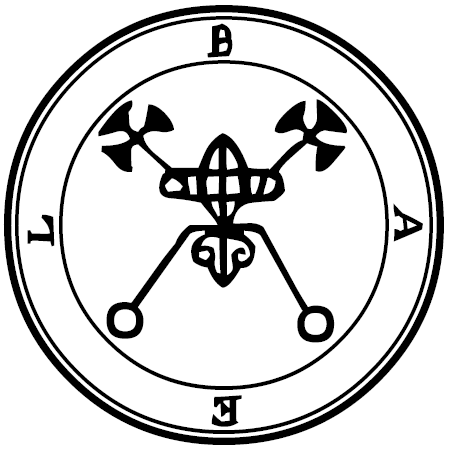
Regardless of method, certain elements recur across traditions. The seal is central — Bael's sigil appears in every approach, whether painted in blood on virgin parchment or printed from a laser jet and taped to a notebook. The direction is East. The day is Sunday. The metal is gold, or at minimum something golden. These correspondences form the irreducible core — the signal beneath the noise of varying methods.
Bael responds to invocation during Sunday or daylight hours, granting invisibility and concealment to the disciplined petitioner who commands his legions with proper rite and sealed intent.